
By Naysa Shrivastava
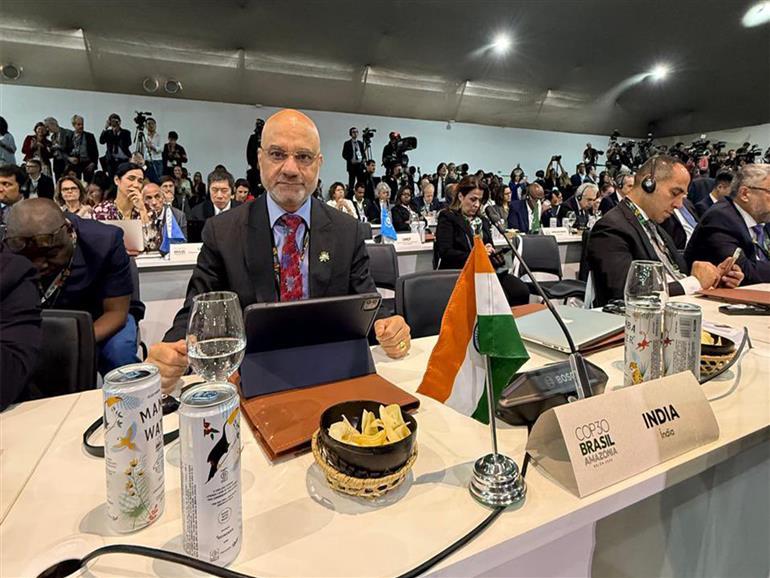
India will be represented by its ambassador to Brazil at the COP30 Leaders’ Summit in Belém on November 6–7, while Environment Minister Bhupender Yadav will take charge of the country’s delegation during the second week of the UN climate conference. The summit, hosted by Brazilian President Luiz Inácio Lula da Silva and UN Secretary-General António Guterres, will see participation from over 140 delegations, including 57 heads of state and 39 ministers.
Prime Minister Narendra Modi is unlikely to attend the event, which will run from November 10–21. Minister Yadav had skipped COP29 in Baku, where India had strongly criticized the $300 billion global climate finance goal as insufficient.
Marking a decade since the Paris Agreement, COP30 will focus on forests, renewable energy, adaptation, food security, and climate finance. India is expected to emphasize that developed nations must rebuild trust by fulfilling earlier pledges and scaling up predictable, grant-based funding for adaptation and loss and damage.
At the pre-COP meeting in Brasília, Yadav urged that COP30 should become the “COP of Adaptation,” stressing the need to move from discussions to concrete action. He highlighted that developing nations face severe resource shortages for implementing climate goals.
India maintains that stronger public financing for adaptation will attract further investments, and warns against introducing new processes that could weaken the Paris framework. For India and other Global South nations, COP30 will test whether climate talks can shift from slow negotiations to tangible, affordable funding solutions.
Brazil will unveil the “Tropical Forest Forever Facility,” a $125 billion initiative to protect forests, alongside the UN’s “Baku to Belém Roadmap to 1.3 Trillion,” which targets mobilizing $1.3 trillion annually by 2035 for developing nations. India’s delegation is also expected to showcase its global initiatives such as the International Solar Alliance, the Coalition for Disaster Resilient Infrastructure, and the International Big Cat Alliance as models of practical multilateral cooperation.
The conference unfolds amid shifting global dynamics, with the U.S. pulling out of the Paris Agreement and several developed economies revisiting their climate strategies due to energy and economic pressures.