
By Lakshmi Jyothish
India’s art market is in the middle of a quiet but visible shift. Once defined by a small circle of elite collectors and blue-chip modernists, the artscape today is widening both in who buys art and what kind of art is being seen, circulated and valued. This change is perhaps most palpable at the Kochi-Muziris Biennale, where the distance between gallery, artist and audience feels increasingly porous.
Galleries across metros are reporting renewed interest, driven largely by younger collectors who are less interested in legacy names and more willing to engage with contemporary, experimental and material-based practices.
Installations, textile works, mixed media and politically inflected pieces are finding audiences beyond the traditional white-cube space. At Kochi, this openness translates into crowds that linger- students, first-time viewers and tourists encountering contemporary art without the pressure to buy or already belong.
“The Biennale has changed how people approach art,” says a Kochi-based gallerist.
“Visitors come with curiosity rather than intimidation. That eventually reflects back into the market.”
While sales are not the Biennale’s stated aim, its influence on taste-making is difficult to ignore. Artists who gain visibility here often find themselves entering conversations with galleries and collectors elsewhere.
This growing accessibility marks a departure from an earlier phase of India’s art market, which leaned heavily on painting-led practices and a narrow canon of artists. Today’s buyers are more inclined to collect works that reflect lived realities-urban anxieties, ecological concerns, caste histories and questions of labour. The material turn in contemporary Indian art, visible in found objects, craft techniques and site-specific installations, signals a market that is learning to sit with complexity rather than spectacle.
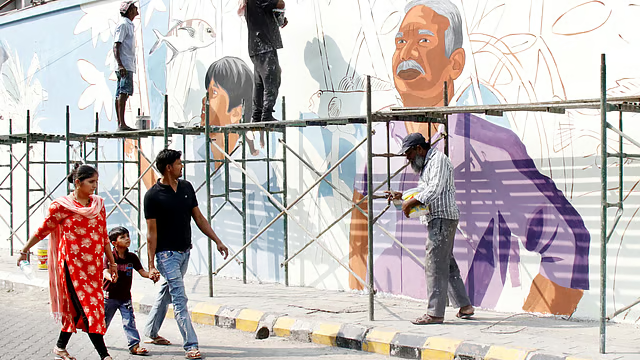
Kochi’s role in this transformation is less about scale and more about sensibility. By placing contemporary art within disused warehouses, heritage buildings and public spaces, the Biennale disrupts the idea that art must be encountered in rarefied settings. This, in turn, nurtures a more confident audience, one that may eventually become a collector, patron or simply a sustained viewer.
As India’s art market matures, its growth is no longer measured only in auction figures or record sales.
This is also reflected in attention spans, in the willingness to engage with difficult work, and in the expanding ecosystem that supports artists beyond metropolitan centres.
The Kochi Biennale, now a recurring fixture in the cultural calendar, stands as both a mirror and a catalyst for this evolving artscape, one that is slowly learning to include more voices, materials and ways of seeing.