
Written by Seekriti Saha
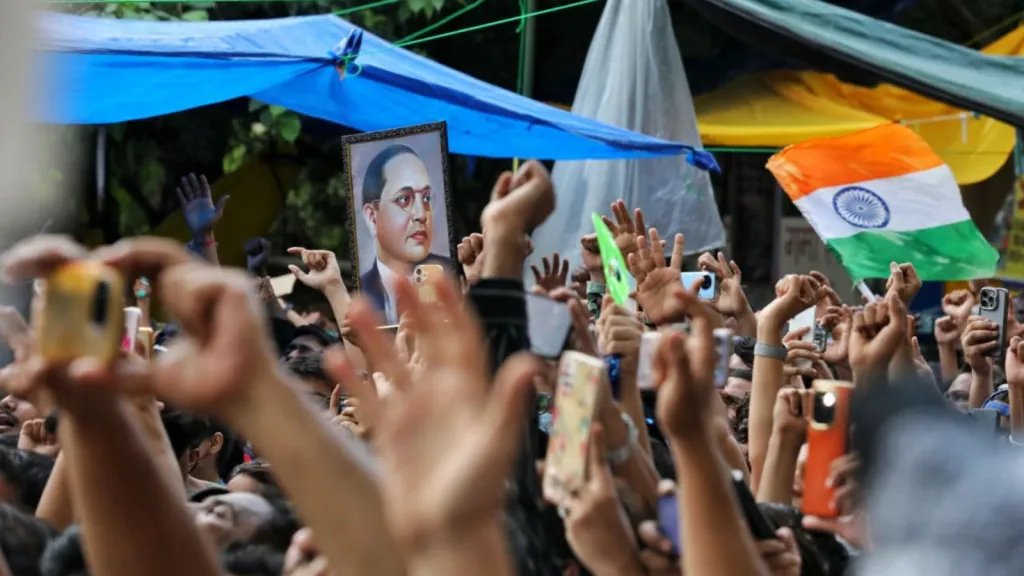
What began as anger over a leaked medical exam has become one of the largest youth-led movements India has seen in years. Thousands of students, ordinary citizens, and professionals from diverse sections came out on the streets to protest. From Jantar Mantar in Delhi to Janpath, and from Pune to Kolkata and even Bolpur, people gathered in large numbers to demand accountability over the 2026 NEET paper leak, as well as alleged irregularities in CBSE’s on-screen marking and what many described as a deeper rot in the nation’s examination system.
The movement’s origin can be traced to an alleged statement by the Chief Justice of India, in which unemployed youth were described as “cockroaches” and “useless parasites.” Instead of retreating from the insult, Indian youth reclaimed it. Activist Abhijeet Dipke formed the Cockroach Janta Party (CJP), a satirical outfit on social media that gained millions of followers within days of its formation.
“What began as an insult was reclaimed as a political symbol,” said Mekhla, a final-year PhD scholar and professor from Kolkata. “The mockery had backfired; the joke had turned against the system itself.”
Protesters demanded the resignation of Union Education Minister Dharmendra Pradhan. When environmentalist Sonam Wangchuk joined students in a hunger strike and was later removed from the protest site by police, anger spread across the nation.
An organised Sansad Chalo march held on 20 July drew what Mekhla called an “extraordinary cross-section of society.” It was no longer just a student movement; people from every walk of life had become “cockroaches.”
Samiksha Choudhary, a 23-year-old student who attended the Janpath rally in New Delhi, was cautious about how much the protests could achieve on their own. “I am not sure the protests alone will bring major changes, but they can increase pressure on authorities to address concerns,” she said. “The deeper issues are corruption and recurring paper leaks, which need systemic action. Protests are necessary to highlight concerns, but they shouldn’t go on indefinitely. They can disrupt students’ lives and public services. The government should respond promptly so that meaningful reforms can happen without prolonged disruption,” she added.
Istuti, a 22-year-old student who protested at Jantar Mantar, saw the government’s response as reactive rather than genuine. “The major decisions were taken under pressure, not out of a sense of accountability or as a choice,” she said.
In Pune, 26-year-old student Rutvika Shinde described the moment as generational. “I would call it the start of the engine of questioning the government,” she said. “The youth of the largest democracy in the world have somewhere understood their right to ask, to question the government, instead of simply facing the consequences of its decisions.”
The sentiment travelled beyond the metro cities. Swastik Chakraborty, a 22-year-old student from Kolkata studying in Bolpur, joined the local demonstration and framed the issue in clear terms. “Education is an extremely crucial tool for the development of a country,” he said. “The respective ministry must be held accountable for the numerous paper leaks in the country, which have cost the lives of several bright students, and must work on the discrepancies.”
Not everyone endorsed the methods of protest. Dr Kamal Krishna Das, a 43-year-old urologist and alumnus of Calcutta Medical College, welcomed the underlying concerns but was critical of the disruptions that followed. “While the 24 July NEET protest highlighted students’ concerns, the demonstration became less effective when it disrupted public life and reportedly led to clashes with the police. Public protest is an important democratic right, but it should remain peaceful and avoid violence, damage to property, or inconvenience to ordinary citizens. In my opinion, constructive dialogue and legal action are more effective ways to bring about lasting change than confrontational street protests,” he said.
Whether this movement becomes a turning point or fades remains contested among the protesters. As Samikhsha put it, “Real change depends on how effectively issues like corruption and paper leaks are tackled.”