
By Rohini Sridharan
Every September 26, World Contraception Day asks a simple question: does everyone have a real choice in family planning? In India, the numbers suggest the answer is still no, mostly for men.
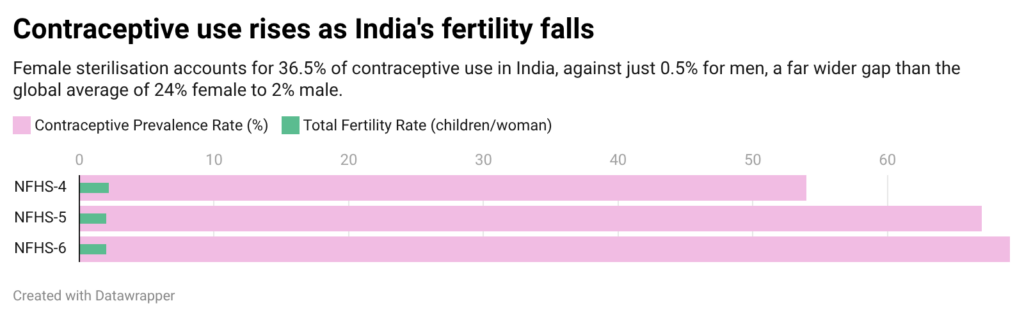
The National Family Health Survey(NFHS)-6, released this year, shows contraceptive use among Indian couples has climbed to 69.1 percent. The country’s fertility rate has also dropped below replacement level, down to 2.0 children per woman. That is good news for population control. But the same survey shows a big imbalance.
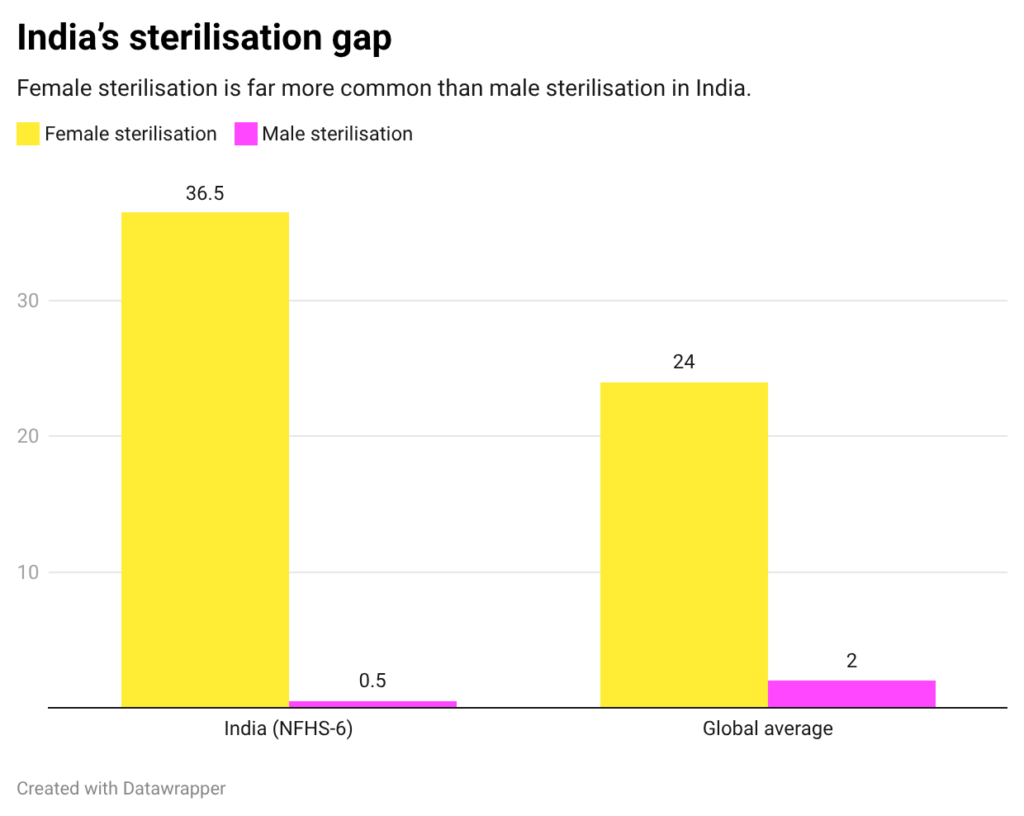
Female sterilisation stands at 36.5 percent. Male sterilisation is just 0.5 percent. Women are choosing, or being pushed toward, a bigger surgery far more often than men.
In NFHS-5, 2019-20, government data recorded about 55,000 male sterilisations across India. In the same year, female sterilisations crossed 34 lakh. That is over sixty times as many. Vasectomy is a simpler, safer procedure than tubectomy. Yet almost no one chooses it.
This is not just an Indian problem, but India does worse than the world average. Globally, sterilisation is about 2 percent male and 24 percent female. India’s gap is even wider.
The gap is also extended to safety. Past survey data shows only 58.7 percent of women who had sterilisation were told about possible side effects. Only half were told what to do if something went wrong. Family planning has quietly become a woman’s job, and a woman’s risk.
World Contraception Day was started to push equal access for everyone. Sixteen years on, India’s own numbers show how far away that goal still is.