
By Shivli Singh
Pune researchers have developed four new varieties of wheat that can be grown under different conditions, including delayed sowing, giving farmers more options as the window for cultivation becomes more and more unpredictable.
The four varieties – MACS 4135 (MACS Mahabal), MACS 6830 (MACS Shivneri), MACS 6837 (MACS Vindhya) and MACS 6854 (MACS Tamhini) – have been developed by the Agharkar Research Institute (MACS-ARI) and identified under the All India Coordinated Research Project on Wheat and Barley Improvement.
The varieties are waiting for official notification by the Central Variety Release Committee for the varieties to be moved toward commercial cultivation.
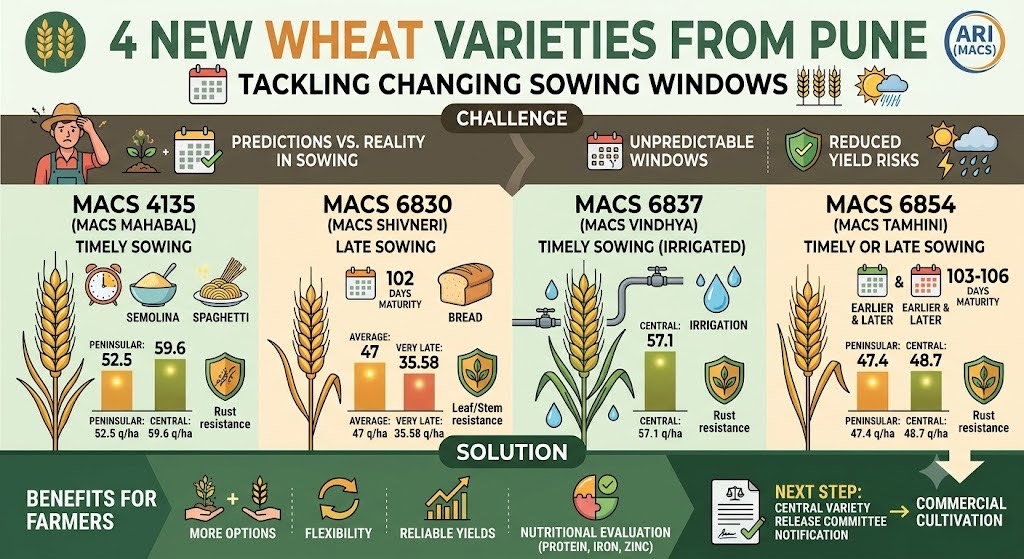
Mahabal and Vindhya are suitable for timely sowings while Shivneri has been developed only for late sowings in the peninsular zone. Tamhini also showed capability to keep yields when planting is late, making the varieties useful for farmers with shorter growing seasons.
Shivneri is a bread wheat variety which matures in about 102 days and gives an average trial yield of about 47 quintals per hectare. It gave 35.58 quintal per hectare even under very late sowing conditions.
It took about 103 to 106 days for Tamhini to mature and it gave average yields of 47.4 quintals per hectare in the peninsular zone and 48.7 quintals per hectare in the central zone. The researchers also identified resistance to leaf and stem rust.
Durum wheat variety Mahabal for timely sowing recorded trial yields of 52.5 quintals per hectare in peninsular zone and 59.6 quintals per hectare in central zone. Its grain is used for making pasta, semolina and vermicelli.
Developed for timely sowing under irrigated conditions in the central zone, Vindhya recorded an average yield of 57.1 quintals per hectare and also exhibited resistance to major forms of leaf and stem rust.
The varieties were also evaluated for their nutritional qualities such as protein, iron and zinc contents.
For farmers, however, the real challenge will be when the varieties are officially notified and reach the fields. The promising trial results could translate to more flexibility and reliable yields in changing sowing conditions depending on how they perform across regions and seasons.