
By Mayank Kumar
When Constable Maharaj Singh stopped to offer four strangers a lift, it was an ordinary act of kindness on a busy highway. By the end of the journey, three people were dead, two were critically injured and several families were left confronting a difficult question: who must compensate a passenger who paid nothing for the ride?
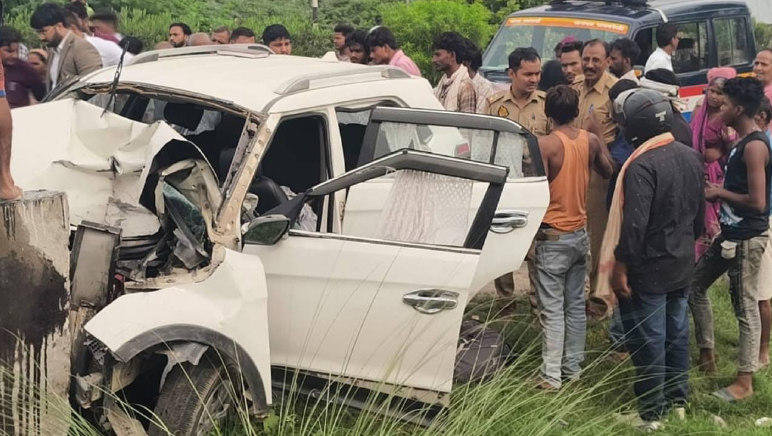
Singh was returning to duty after four days of leave when his Hyundai Creta crashed into a roadside culvert near Khairahni village in the Bachhrawan Kotwali area on the Lucknow–Prayagraj highway. The accident occurred at around 8 am on July 15.
The impact crushed the front of the SUV. Singh, who was posted on security duty at the Raebareli civil court, died in the crash. Retired head constable Chandrapal Singh, 72, was also among the deceased. The identity of the third person reported dead has not been confirmed by police, as published accounts conflict.
Two injured passengers, identified in reports as Mohammad Rayyan and Rajat Sahu, were referred to a trauma centre in Lucknow in critical condition.
According to preliminary reports, Singh had picked up two passengers near Nigoha and another two at the Bachhrawan border. They were not relatives, employees or paying customers. They were simply people travelling in the same direction.
Police have not conclusively established why the vehicle left the road. Speed, driver fatigue and a possible loss of control are among the circumstances that investigators will have to examine. Until mechanical inspection, witness statements and other evidence have been considered, describing the crash as the result of rash driving would be premature.
The tragedy brings attention to the legal position of a “gratuitous passenger” — a person travelling in a vehicle without paying a fare.
Under Section 147 of the Motor Vehicles Act, an insurance policy must cover specified third-party risks. The provision expressly excludes gratuitous passengers travelling in a goods vehicle from compulsory passenger coverage. Supreme Court judgments, including New India Assurance Co. Ltd. v. Asha Rani, have consequently limited an insurer’s statutory liability for passengers carried free of charge in goods vehicles.
The Raebareli accident, however, involved a private car. That distinction matters.
For the victims’ families, the most important document may now be Singh’s insurance policy. If the Creta had only a liability or “Act-only” policy, the insurer could dispute responsibility for its occupants. If it had a comprehensive or package policy, the position may be different.
The Supreme Court held in National Insurance Co. Ltd. v. Balakrishnan that a comprehensive or package policy covers an insurer’s liability towards occupants of a private car. Therefore, the case may not depend exclusively upon whether Singh purchased a separate unnamed-passenger add-on. The wording and category of the actual policy will determine the insurer’s responsibility.
“In a private-car accident, the first step is to examine whether the vehicle had an Act-only policy or a comprehensive package policy. A free passenger does not lose the right to approach the Motor Accidents Claims Tribunal merely because no fare was paid. The tribunal will examine negligence, the insurance contract and the liability of the owner before deciding who must pay,” says Divyansh Singh, a law practitioner handling the case.
The legal representatives of the deceased passengers and the injured survivors can approach the Motor Accidents Claims Tribunal, commonly known as MACT. Depending on the evidence and policy terms, a claim may be pursued against the insurer, the vehicle owner’s estate or both.
If the insurer establishes that the risk was outside the policy, claimants may ask the tribunal to apply the “pay and recover” principle. Under this approach, a court may direct an insurer to compensate victims first and later recover the amount from the vehicle owner. Its application, however, is not automatic and depends upon the facts, policy conditions and relevant judicial precedent.
If evidence establishes rash or negligent driving, Sections 281 and 106(1) of the Bharatiya Nyaya Sanhita may ordinarily become relevant. Section 281 addresses rash or negligent driving on a public way, while Section 106(1) covers death caused by a rash or negligent act.
But Singh died in the same accident. Criminal responsibility is personal and cannot be transferred to his family. Any prosecution against him would therefore abate. His heirs may face questions relating to the vehicle’s estate or civil compensation, but they cannot inherit his criminal liability.
That leaves two very different memories of the same man: a driver whose conduct must be investigated and a constable whose final journey began with an attempt to help strangers.
For the bereaved families, the answer will lie not only in how the Creta crashed, but also in the fine print of the policy it carried.