
By Prachi Mishra
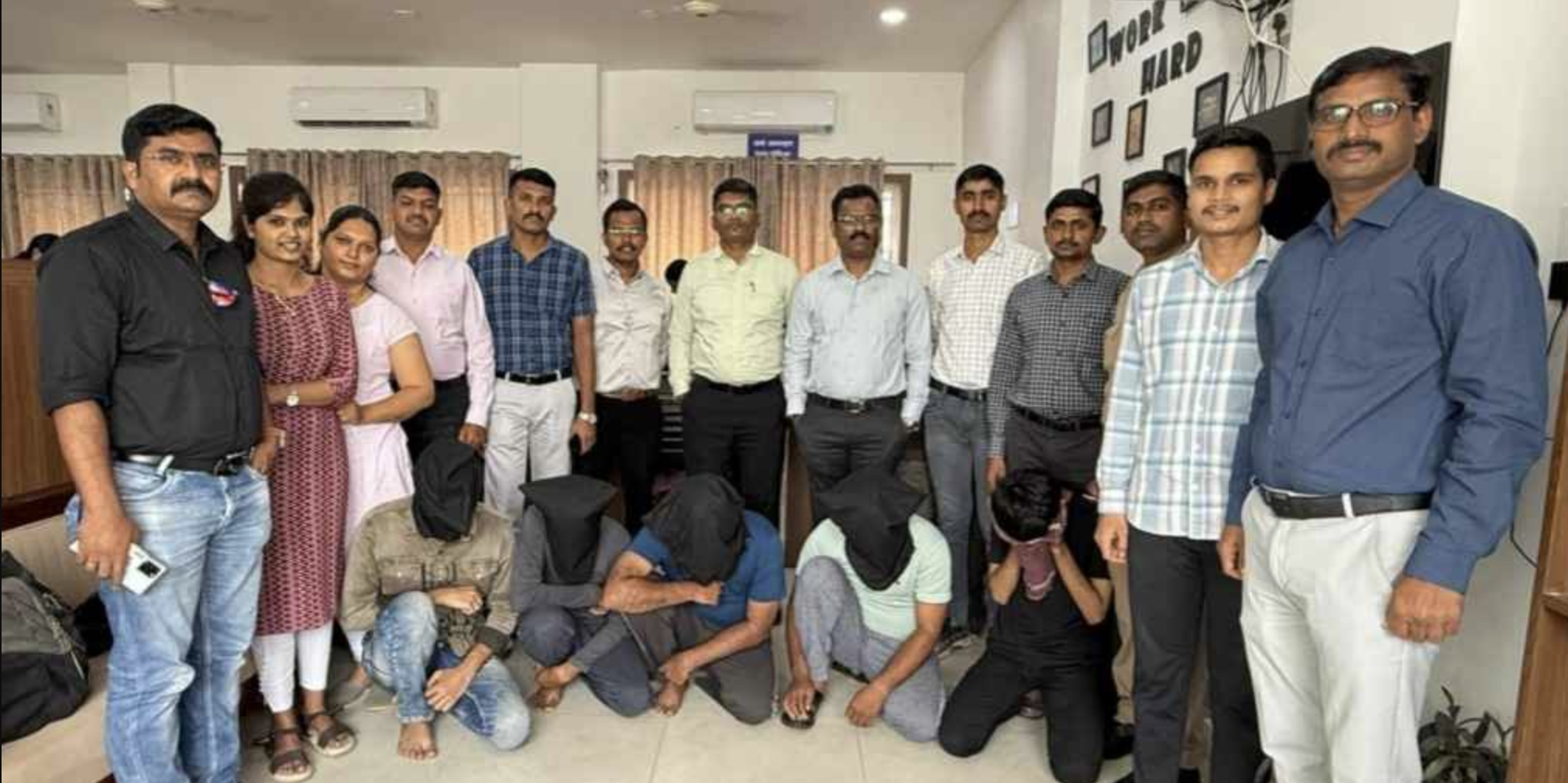
Pimpri Chinchwad cyber police have unearthed a large-scale online share-trading fraud that duped over 150 investors of nearly ₹20–25 crore. The breakthrough came after five people were detained in a raid at a hotel in Kondhwa, Pune.
Deputy Commissioner of Police (Crime) Dr. Shivaji Pawar confirmed that two of the accused were prime handlers who maintained direct communication with Mandarin-speaking masterminds through encrypted messaging platforms. The arrested men were identified as Yasir Abdul Majid Shaikh (34) of Undri, Mohammed Sultan Zeheruddin (30) of Patna, Maz Afsar Mirza (24) of Swargate, Hussain Tahir Shaikh (23) of Chhatrapati Sambhajinagar, and Baburao Shivakiran Meru (41) of Hadapsar.
The case surfaced when a software professional from a pharmaceutical company was cheated of ₹89.35 lakh after responding to a social media advertisement promising abnormally high returns. He was lured into a fake mobile application where his “earnings” were shown as ₹8.7 crore, though his actual deposits were quickly routed through several bank accounts and converted into cryptocurrency.
Investigators later discovered that the gang confined mule account holders in hotel rooms to control transactions. Four portable CCTV cameras linked to cloud servers were found, allowing both local handlers and Chinese controllers to remotely monitor the mules. Lookouts were deployed outside these rooms to prevent escape until the accounts were frozen by banks or authorities.
According to Assistant Police Inspector Pravin Swami, Shaikh and Zeheruddin acted as coordinators for mule accounts, while the remaining trio guarded and tracked the mules’ movements. Along with phones, SIM cards, and debit cards, the CCTV devices were seized during the operation.
Police Commissioner Vinaykumar Choubey, who oversaw the probe, said the syndicate followed a systematic method: mule handlers would arrange hotel stays, obtain account credentials including SIM cards, chequebooks, and debit cards from individuals, and then use these accounts to funnel illicit funds abroad. Once flagged and frozen, the mules were compensated and released.
Earlier investigations into a Cambodia-linked cyber network had already hinted at a shadow system of hotel bookings across Pune. The recent arrests, however, highlight how deeply embedded such rackets are and how international syndicates exploit local networks to move stolen money.