
By Hanika Kashyap,
One protest. Two cities. Two very different experiences.
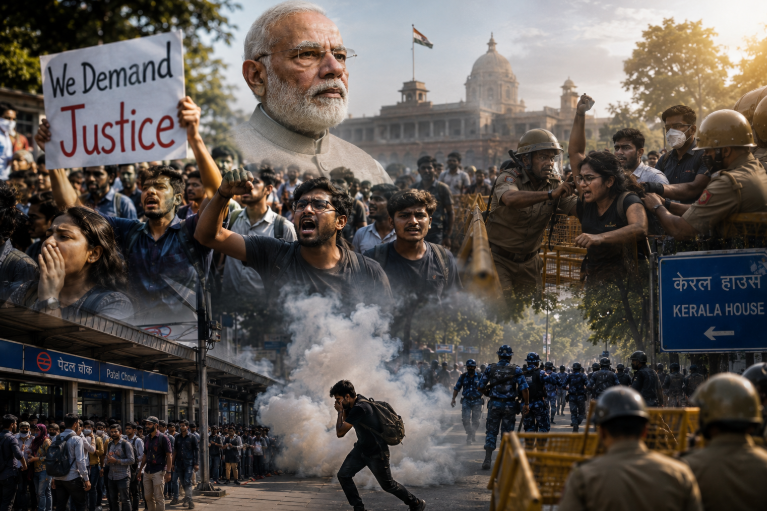
As students took to the streets demanding accountability over alleged examination irregularities, their experiences revealed starkly different forms of policing. While protesters in Mumbai described a peaceful demonstration despite detentions, those in Delhi spoke of tear gas, lathi charges, and restricted movement, raising larger questions about the safety of protesters in India.
For 22-year-old Yuvi Gote, who participated in the protest at Dadar, Mumbai, the demonstration remained “peaceful” despite ending in detention.
He said the police tried to divide the large crowd into smaller groups by identifying those who were louder, standing on others’ shoulders, or carrying extravagant posters.
He wasn’t mistreated or mishandled, but he was detained.
“The junior officers were reluctant,” he recalled. “They had to do it because of their job.”
Gote was made to walk nearly 30–40 minutes as police shifted him from one van to another before taking him to a chowki. Eventually, he was released without ever seeing the inside of a police station.
One conversation stayed with him.
He asked one of the officers whether he would have detained his own children had they been protesting.
“The cop didn’t even know what the protest was about,” Gote said. When the officer understood that students were protesting alleged paper leaks, he was “in shock.”
Delhi painted a different picture.
Naysa Shrivastava, who attended the protest near Jantar Mantar, recalled that reaching the protest itself was difficult.
She said metro trains skipped Patel Chowk station despite carrying passengers who weren’t even headed to the protest.
“The stations announced that the doors were stuck, or that due to security reasons they wouldn’t stop at the station,” she said.
She added that while reporters were allowed out after waiting 15–20 minutes, everyone else waited another 30–40 minutes. Even then, protesters weren’t allowed to exit through the main gate and instead had to walk through small lanes to reach the protest site.
“There, I saw protesters at Kerala House being lathi charged,” she said.
She also faced tear gas herself.
“The tear gas became so intense that we had to rush out,” she said.
The contrast between the two cities highlights how differently demonstrations can unfold. While Mumbai protesters largely described detentions without violence, Delhi protesters reported crowd-control measures that included restricted movement, lathi charges, and tear gas. According to media reports, police detained several protesters in both cities as the demonstrations continued.
To understand the police perspective, I spoke to Mrityunjay Kumar Singh, a Deputy Superintendent of Police (DSP), who was not posted at the protests but shared his understanding of how such operations function.
“First of all, it was not only the Delhi police; there were multiple forces used there. When you have multiple forces like the CRPF, BSF, the Army, and the Delhi police, you get multiple commands, and then there are chances of something going wrong in the command, in the order itself,” he said.
While he wasn’t aware of who gave the top-level commands, he said, “Out of 1,000 men, it is only 50 or 100 who have gone berserk or who have been using foul language.”
At the same time, he did not defend every police action.
“What is wrong is wrong,” he said.
When asked whether charges filed against protesters could affect their future, Singh said he did not believe the police were acting independently.
“I don’t think the police are operating on their own. There were orders from above,” he said.
He added that police generally see student protesters as their “own children” and would not want to harm them.
To understand the legal implications, I spoke to a lawyer who requested anonymity.
He explained that some protesters have reportedly been booked under Section 109 of the Bharatiya Nyaya Sanhita (BNS) for attempt to murder, a non-bailable offence. Protesters booked under this section can be arrested without a warrant, making anticipatory bail the immediate legal remedy. Adults would face trial under regular criminal procedure, while minors would be sent to juvenile court.
However, the lawyer noted that this charge is uncommon in protest-related cases. More common charges include voluntarily causing hurt, assault, deterring a public servant, wrongful confinement, unlawful assembly, rioting, criminal intimidation, criminal trespass, and damage to public property.
While Union Education Minister Dharmendra Pradhan did resign, many students say accountability cannot stop with one individual. They view it not as a victory, but as a step towards broader reforms and greater transparency.
India has a long history of protests influencing public policy, from Anna Hazare’s 2011 hunger strike that intensified demands for an anti-corruption law, to the farmers’ protests that led to the repeal of the three farm laws in 2021. Hunger strikes have often served as a last resort, forcing governments to acknowledge public pressure and respond to demands for accountability.
Whether through detention in Mumbai or tear gas in Delhi, the experiences of these protesters show that exercising the constitutional right to protest can look very different depending on where one stands.