
By Gitika Sharma
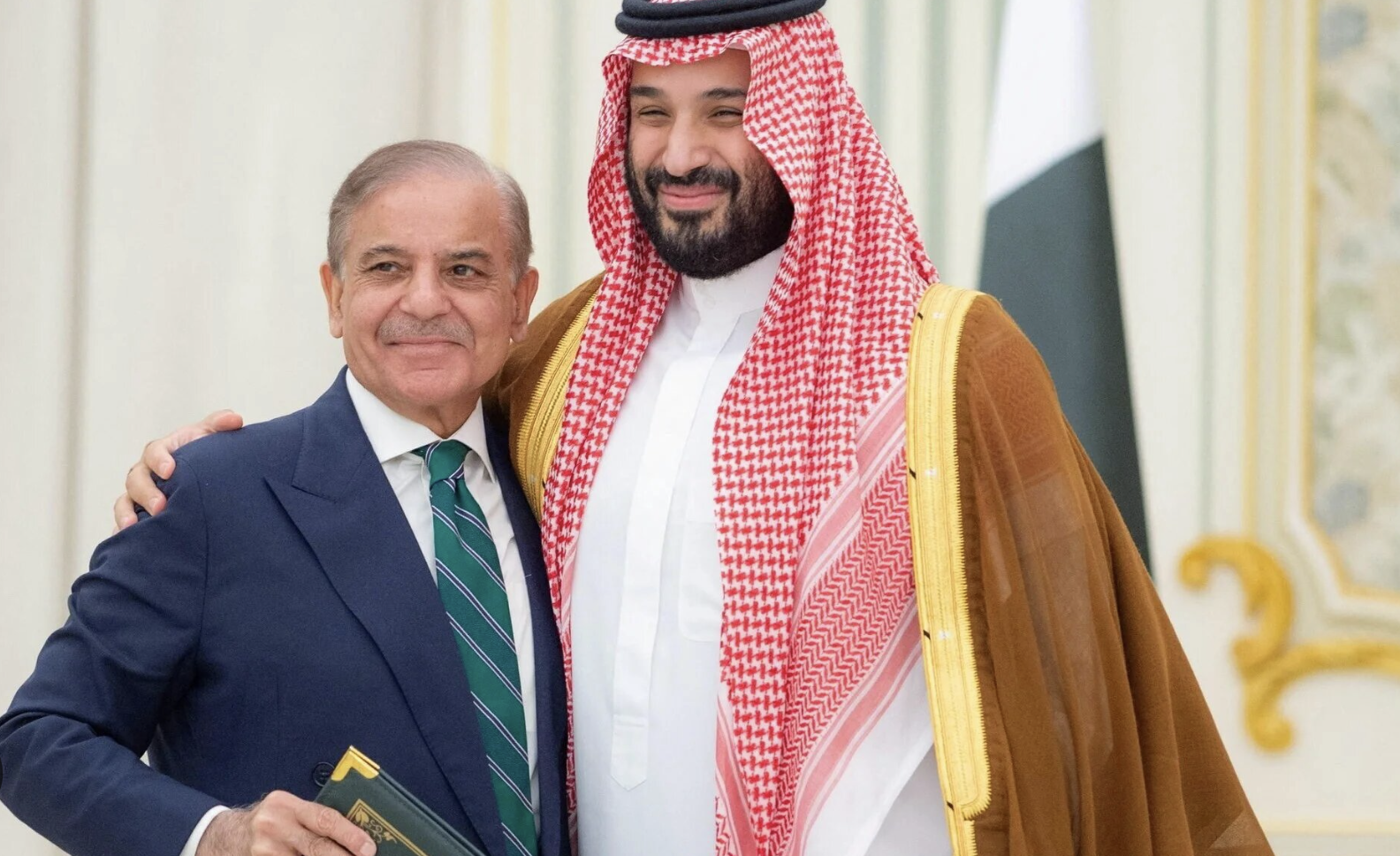
On Wednesday, in Prime Minister Shehbaz Sharif’s state visit to Riyadh, Saudi Arabia and Pakistan signed their largest nuclear and defense agreement to date, elevating decades of defense cooperation into a formal collective security agreement. The historic agreement binds the two nations to hold an attack on either as an attack on the two nations, in a historic shift of defence alignments in the region.
Not only is the pact of particular rhetorical interest, it is also of interest for its scope. Officials noted that it went beyond the typical military aid to incorporate mutual deterrence measures, intelligence collaboration, training coordination, and agreements concerning nuclear and advanced defence cooperation. In doing so, Islamabad and Riyadh formalised something that for years was an informal practice and enshrined it as one of the region’s most important bilateral defence agreements.
India’s response was deliberately cautious. The Ministry of External Affairs framed the pact as formalising old relationships but emphasized that it would review the national security implications. Commentators deduce that New Delhi will be reviewing whether the agreement alters the region’s balance of power, not least because India itself has sought to become the main global security partner through stepped-up defence and technology collaborations with the United States, France, Japan, and the Middle East.
Timing is also critical. It comes at a moment of added geopolitical strain — from fluid Gulf alliances to unresolved South Asian security rivalries. For Saudi Arabia, keeping officially in step with nuclear-tipped Pakistan provides strategic depth in that region of the world where old assurances are being reconsidered. For Pakistan, the deal boosts international reputation at times of economic fragility and internal issues.
India, in the meanwhile, has to strike a delicate balance. As much as its emerging ties with Gulf countries, particularly Saudi Arabia and the UAE, are a reflection of its emerging international standing, the Riyadh-Islamabad defence agreement is a reminder of the complicated dualities involved. The alertness of New Delhi is likely to be higher, for any shift in the military balance could impact its region-specific security calculus as much as its overall global positioning.
Both Saudi Arabia and Pakistan believe that the agreement is defensive, to deter external aggression. But its sheer scale and nuclear undertones ensure that it will be maintained under intense Indian and wider global scrutiny.