
By Aditi S Bade
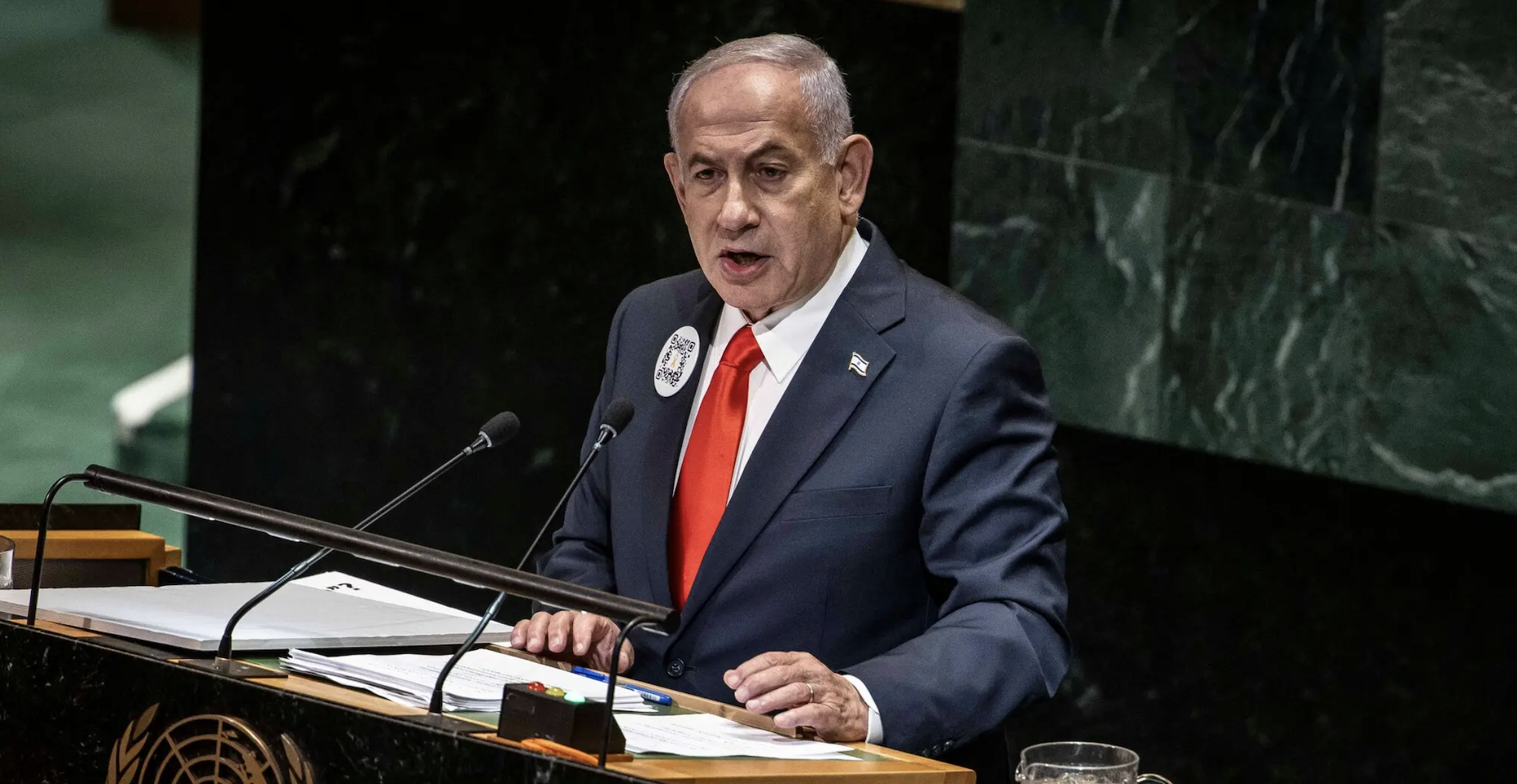
After reaffirm ING Israel’s military operations in Gaza and criticized the recent recognitions of Palestinian statehood, Prime Minister Benjamin Netanyahu was the target of a coordinated diplomatic walkout, massive protests in New York City, and a wave of international censure during a raging storm of events at the UN General Assembly. Dozens of delegates from various countries left the hall on September 26 as Netanyahu was taking the podium to express their disapproval of Israeli actions in Gaza and to indicate diplomatic isolation. Much of the seating in the assembly was empty. Thousands of people marched through Manhattan’s streets, chanting “Free Palestine,” calling for an arms embargo on Israel, and demanding that Netanyahu be arrested in accordance with the ICC’s (International Criminal Court) warrant.
Netanyahu made a direct and unrepentant speech. He denounced recent Western attempts to recognize a Palestinian state as “sheer madness” and implied that granting Palestinians statehood would “encourage terrorism.”
He denied that Israel was committing genocide, framing allegations as part of a “blood libel.” Repeatedly, he returned to a singular refrain: Israel “must finish the job” against Hamas in Gaza, vowing to continue the offensive despite condemning voices. In an unconventional move, Israel claimed it had used loudspeakers on its border and commandeered mobile phones in Gaza to broadcast Netanyahu’s speech directly to Gaza residents. The speech itself included a map titled “THE CURSE,” meant to highlight what Netanyahu portrayed as an “Iranian terror axis” extending through the region. Many world leaders and observers responded with condemnation. Ireland described Israel’s actions in Gaza as “an abandonment of all norms, all international rules and law.”
The likes of France, Canada, the UK, and Australia-the nations that had just acknowledged the state of Palestine-felt that Netanyahu’s refusal of these measures was an insult toward the emerging diplomatic consensus. The reports suggest that the European Union is considering raising tariffs and sanctions against Israel.
Inside Israel, some believe that the prime minister has taken a hard stance that aggravates the conflict and deepens the impasse. While delivering his speech, Netanyahu tried to reach out to the voices of hostages whom he maintained were still alive by naming them, saying he had not forgotten them.
This is a matter of division within UN itself. While the UN General Assembly has adopted a few resolutions (which are nonbinding) calling for the creation of a Palestinian state, full membership at the UN would need the Security Council’s approval, a path obstructed by the US veto. Meanwhile, the ICC is proceeding to investigate allegations of war crimes in Gaza, while South Africa is initiating genocide proceedings against Israel at the International Court of Justice.
Toward the end of his remarks, Netanyahu disregarded the walkouts, saying that Israel would press on undeterred. “We will fight for our people. We will win,” he claimed. Still, his stuttering in New York was witness to how deeply isolated Israel has become and how fraught the road ahead was going to be.