
By Srijita Chakraborty
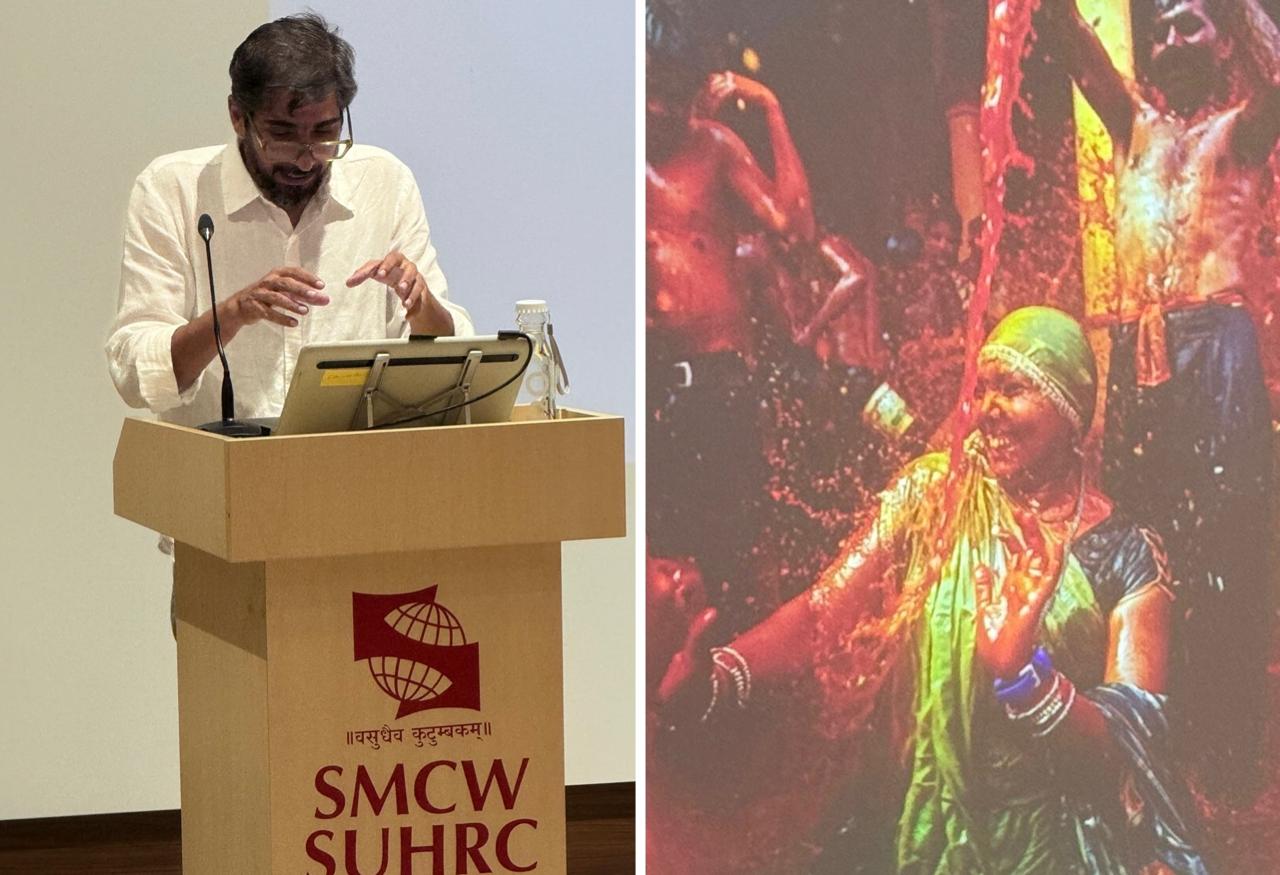
On August 21, to mark the celebrations of World Photography Day, renowned photojournalist and three-time Pulitzer Prize winner Adnan Abidi took a session at Symbiosis Medical College for Women (SMCW). The event was hosted by Symbiosis School of Visual Arts and Photography (SSVAP) for students of Symbiosis Institute of Media and Communication and SSVAP, and was Abidi’s first-ever formal interaction with students. With a career spanning over two decades, he has covered stories of tears, joy, deprivation, injustice, war, loss, and hope.
Abidi has worked with Pan-Asia News Agency (PANA), Indo Photo News, and Press Trust of India before joining Reuters in 2005. Since then, he has covered a wide spectrum of subjects including politics, natural disasters, economics, sports, and human tragedies. His coverage of the Rohingya exodus won him a Pulitzer Prize for Feature Photography in 2018. He earned his second in 2020 for documenting the Hong Kong protests and his third in 2022 for his coverage of the COVID-19 crisis in India.
Speaking about covering protests, including those in Hong Kong and Delhi, Abidi noted that working in the field requires farsightedness and the ability to find “a story within a story.” He recalled how unpredictable protest sites can be: “mob has no face,” he said, stressing the importance of being street-smart, reading body language, and adapting quickly.
While Abidi believes that in visual storytelling emotions take precedence over technique, he reiterates the importance of balance. “A good journalist always thinks with his mind and shoots from his heart, that is the only way to avoid bias,” he told students.
Recalling his time covering the Rohingya exodus, Abidi shared the story of Nur Hafes, a boy who lost his father and took on the responsibility of supporting his family. Spending nearly two weeks with Hafes’s family, Abidi not only captured powerful images but also built deep human connections. “You must sit with people, talk to them, make them immune to your process,” he advised budding journalists.
On covering tragedies like the COVID-19 pandemic, he highlighted the importance of self-preservation: “If you are scared, that is the best thing. Fear makes you cautious, and thinking of your family compels you to ensure your safety.” He further stressed that originality and research are essential. “Go into the field with a blank canvas in your mind. Don’t repeat what has already been shot.”
As concluding thoughts, Abidi reminded students that while media tools and technologies are constantly changing, what remains crucial is the responsibility to tell the truth with respect and empathy for the subject. “The instrument doesn’t matter anymore; what matters is capturing the truth and showing it to people in a way that moves them,” he said.
The hour-and-a-half-long session was insightful and ended with an interactive Q/A session between the students and the renowned photographer.