
BY IVASHREE
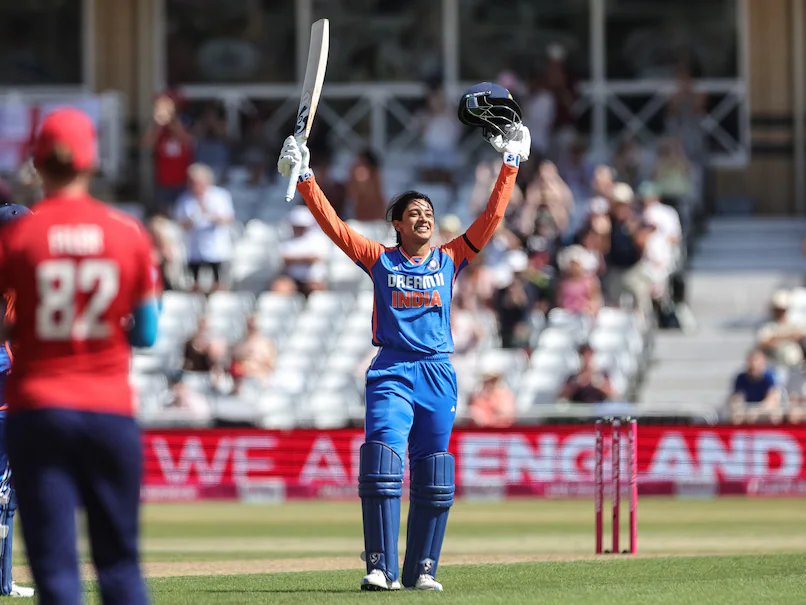
Evaluating Smriti Mandhana’s career purely through milestones risks understating her true standing in international women’s cricket. A more revealing assessment emerges when her performance metrics are placed alongside those of her global contemporaries. When viewed through this analytical lens Mandhana’s career reflects not just excellence, but sustained competitiveness at the highest level.
In T20 Internationals, Mandhana recently became the first Indian woman to cross 4,000 runs, a benchmark that places her among an elite global group. Compared with openers such as Suzie Bates and Meg Lanning, Mandhana’s strike rate hovering above 120 stands out given the conditions in which she often plays. Indian batters traditionally face slower pitches and higher spin workloads, yet Mandhana maintains scoring efficiency comparable to peers operating in more batter friendly environments.
From an innings impact perspective, Mandhana’s value as an opener becomes clearer. Data trends show that when she scores 30 or more in T20Is, India’s win percentage increases significantly mirroring patterns observed in Australia when Lanning anchors the top order.
While Lanning’s numbers reflect dominance through volume and leadership, Mandhana’s suggests influence through momentum creation, setting platforms rather than finishing innings.
In One Day Internationals, Mandhana’s statistical profile aligns even more closely with global greats. With an average in the high 40s and a healthy conversion rate of fifties to hundreds, she compares favorably with Tammy Beaumont and Laura Wolvaardt. Notably, a high proportion of Mandhana’s centuries have come while chasing targets, a metric often associated with composure and game awareness rather than raw dominance.
Shot selection analysis further strengthens her case. Mandhana scores a majority of her runs along the ground, particularly through the off side, which reduces dismissal risk. Compared with power focused batters who rely heavily on aerial strokes, her approach yields a lower balls per dismissal ratio in ODIs. This technical efficiency allows her to remain effective across formats without drastic stylistic adjustments.
Longevity is another key differentiator. Since 2018, Mandhana’s year by year run output has shown minimal decline, despite an increase in match volume and travel demands. Several global peers have experienced sharper performance fluctuations due to workload management or injury cycles. Mandhana’s relative durability suggests strong conditioning and technical repeatability traits increasingly valued in data driven team selections.
In franchise cricket, Mandhana’s impact mirrors international trends. Teams featuring her at the top of the order record higher powerplay scoring rates without a corresponding rise in wicket loss. This balance places her in a narrow category of batters who combine stability with acceleration, an attribute shared by only a handful of elite players worldwide.
Analytically, Smriti Mandhana does not dominate every statistical column, but her consistency across conditions, formats and competitive contexts elevates her standing. When compared globally, she emerges not merely as India’s premier batter, but as a benchmark of modern efficiency in women’s cricket one whose value lies in reliability as much as brilliance.