
By Sunita D
Picture a product launch unlike others. Instead of the usual fanfare, the room is subdued. Engineers speak of sleepless nights. Executives invoke words like a “Catastrophe”and “extinction”, as though they are confessing to something rather than unveiling it. It feels less like a demo and more like a warning. Then, a few months later the product ships anyway, available to anyone willing to pay for it
This scene has played out repeatedly since the current wave of artificial intelligence. No fast food chain has ever warned customers that its newest burger is too dangerously delicious to serve responsibly. Yet in the AI industry, warnings of doom have become part of the sales pitch.
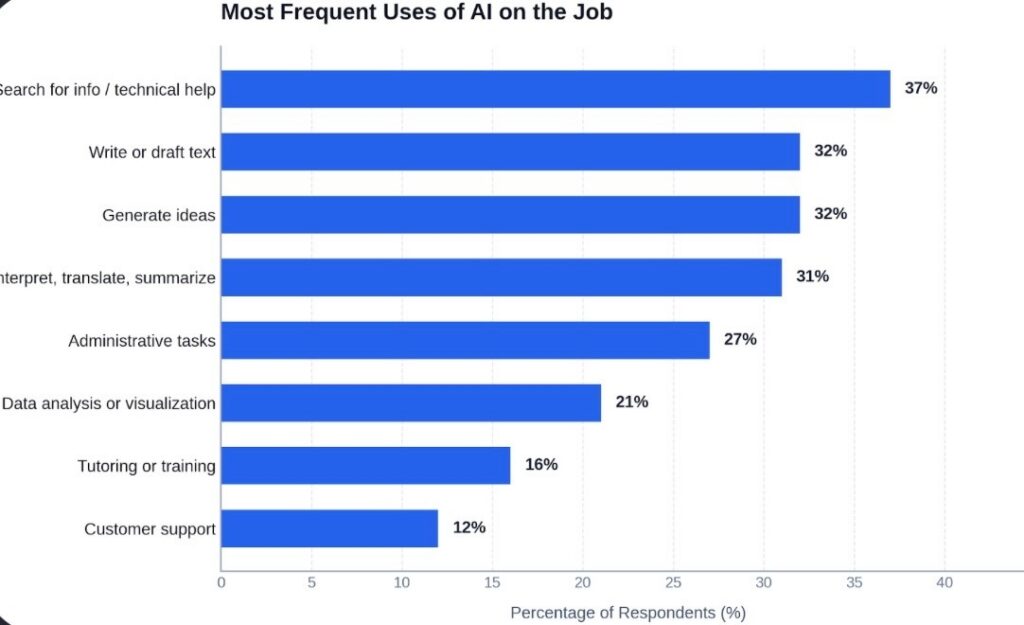
Image caption: how professionals use AI on the job. ( Infographics source: CBS news, curated and presented: Salonee)
In 2015, years before OpenAI released ChatGPT, it’s co-founder Sam Altman said: “AI will probably most likely lead to the end of the world, but in the meantime, there will be great companies.” He has since said, in public interviews, that he sometimes wonders whether launching chat GPT was a mistake.
He is not alone. In 2023, hundreds of technology leaders including all Altman, Anthrophic’s Dario, Microsoft founder Bill Gates and Google Deepmind chief executive Demis Hassabis, signed a one line statement declaring that mitigating the risk of an AI-driven extension should be treated as seriously as pandemics or nuclear war.
That same here, Elon Musk backed an open letter calling for a 6 month pause on advanced AI development. Less than 6 months later, he launched his own AI company xAI.
The business of fear
Critics argue there is a simpler explanation for this pattern than genuine alarm. Framing a product as powerful enough to end the world, they say is effective marketing, it signals capability without the company having to prove it. It also carries a second, more useful message: that only the firms building this technology are responsible enough to control it, an argument that conveniently discourages external regulation.
Meanwhile, they argue, the harms already unfolding,job losses, biased algorithms, the enormous energy costs of running these systems, receive comparatively less attention next to hypothetical disasters that may be decades away, if they arrive at all.
None of this proves that AI carries no genuine risk. But the pattern is familiar enough to warrant a simple question: when a company insists its own creation might end the world, who really benefits from the belief being widely held?