
By Ria Jain
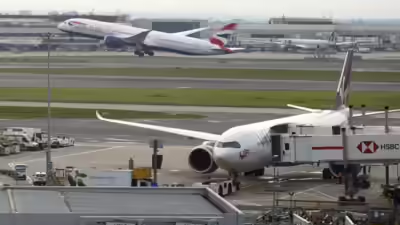
Several airports across Europe on Saturday faced disruptions in check-in and boarding systems due to a cyberattack on the third-party service provider. The authorities at London’s Heathrow, Brussels, and Berlin airports have confirmed that there have been delays and cancellations of flights.
Some of the affected airports include the continent’s busiest airport, Heathrow, where 651 departures were scheduled for the day; Berlin Airport, with 226 departures; and Brussels Airport, with 228 departures, out of which more than 29 have been cancelled.
London’s Heathrow has confirmed that Collins Aerospace, the service provider for the airport and various others, is facing technical issues that have become a cause of delays for the departing passengers. The parent company has also stated that they’re aware of the “cyber-related disruptions” caused to their MUSE software at select airports.
They’ve also said that they are actively working on resolving the defect and restoring all functions for the customers as soon as possible. Although RTX, in an email statement, mentioned that the impact was only on electronic customer check-in and baggage procedures and it could be mitigated through a manual process for the time being.
Passengers at various affected airports have also been advised to check with their airlines before leaving for the airport. Berlin Airport even published a notice stating that there might be long waiting lines for check-in due to the technical difficulties. Further, Frankfurt Airport and Zurich Airport have confirmed that they remain unaffected.
These disruptions have been the latest in a series of cyberattacks and ransomware attacks that target governments and companies all over the world. They’re targeting all sectors, from healthcare and defence to auto and retail. Even Jaguar Land Rover had to halt their production after one such breach.