
By Gitika Sharma
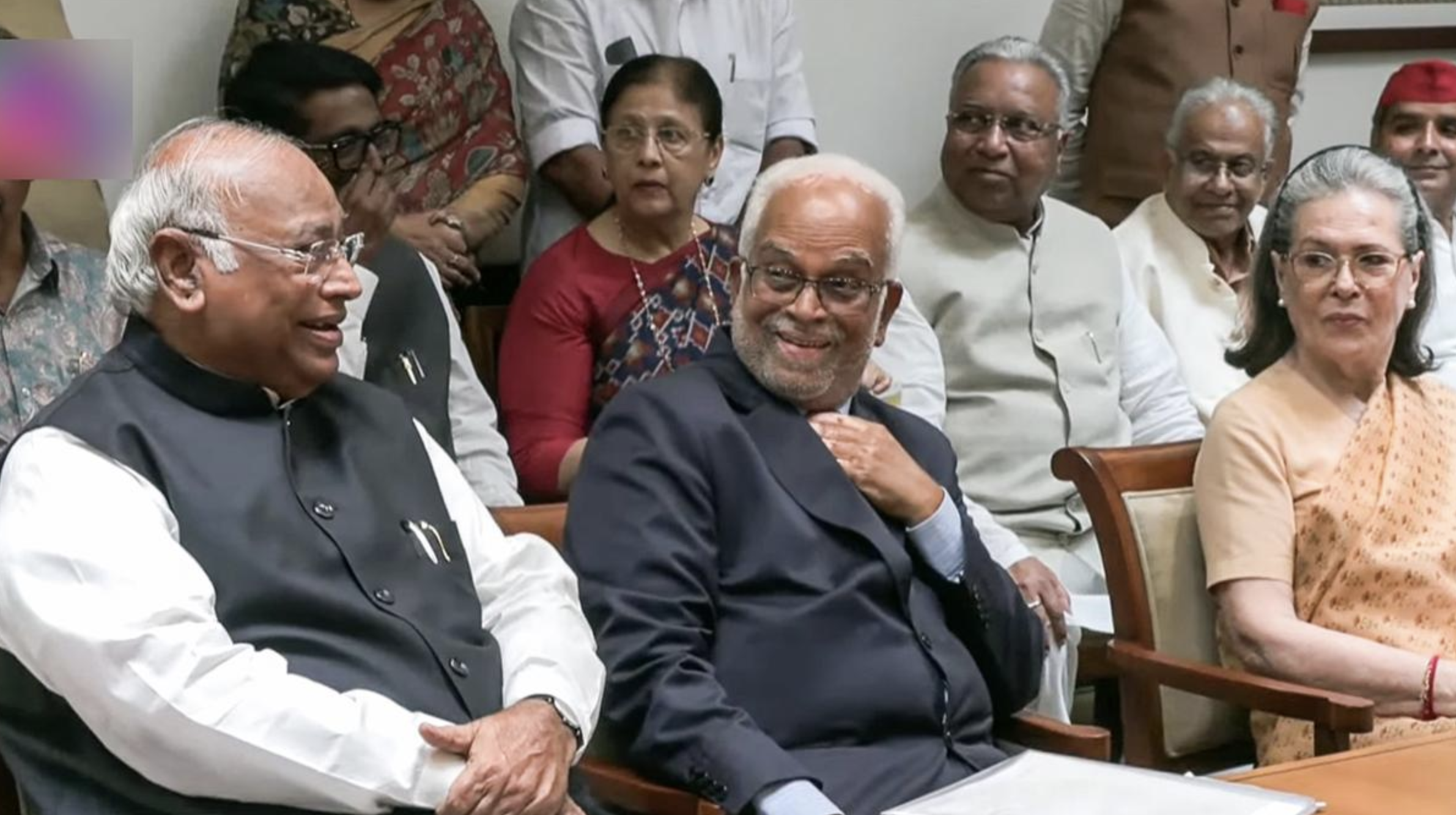
On September 8, one day before the vice-presidential election, the opposition will hold a brief training session for all its MPs. Although the National Democratic Alliance holds a strong advantage in the election, the Opposition aims to reduce the winning margin of government candidate C.P. Radhakrishnan.
Congress president Mallikarjun Kharge has reached out to the leaders of the Opposition parties, inviting them and their members to the training session. Members from both Houses of Parliament make up the electoral college for the election of the Vice-President.
The MPs are free from any party whips and may vote according to their own choice. A preferential voting system is employed, granting the voter as many preferences as there are candidates.
In the contest are only Maharashtra Governor and NDA candidate Mr. Radhakrishnan and joint Opposition nominee, former Supreme Court judge Justice B. Sudershan Reddy (retd.). The combined strength of the two Houses stands at 786, with six positions empty, one in the Lok Sabha (Basirhat, West Bengal) and five in the Rajya Sabha (four from Jammu and Kashmir and one from Punjab after the AAP MP Sanjeev Arora stepped down upon securing the byelection to the Punjab Assembly).
The NDA includes 422 members (293 Lok Sabha MPs and 129 Rajya Sabha MPs), while the Opposition has 320 members. The Biju Janata Dal (BJD), unaffiliated with any coalitions, has not yet established its position. The BJD has seven representatives in the Upper House and no representatives in the Lok Sabha.
The Lok Sabha includes four Independents and nine members from non-aligned parties. Justice Reddy, in the meantime, has issued a written request to all MPs asking for their backing. He stated that the election was not just a decision between two people but essentially a choice of ideology.
In addition to which a member of opposition stated that it entails reaffirming the core concept of India as envisioned by our freedom struggle and embodied in our remarkable Constitution, an India dedicated to achieving complete social, economic, and political justice, an India where dissent is embraced, honored, and respected, and an India where institutions are perceived as serving the people with autonomy and equity.
The forthcoming Vice-Presidential election is proving to be more than merely a matter of figures. Although the NDA holds the advantage, the Opposition relies on strategy, unity, and Justice Reddy’s appeal to convey a message. The outcome will show not only the victor but also the changing dynamics of political power within Parliament.