
By Dhruvi Shah & Sagarika Rastogi
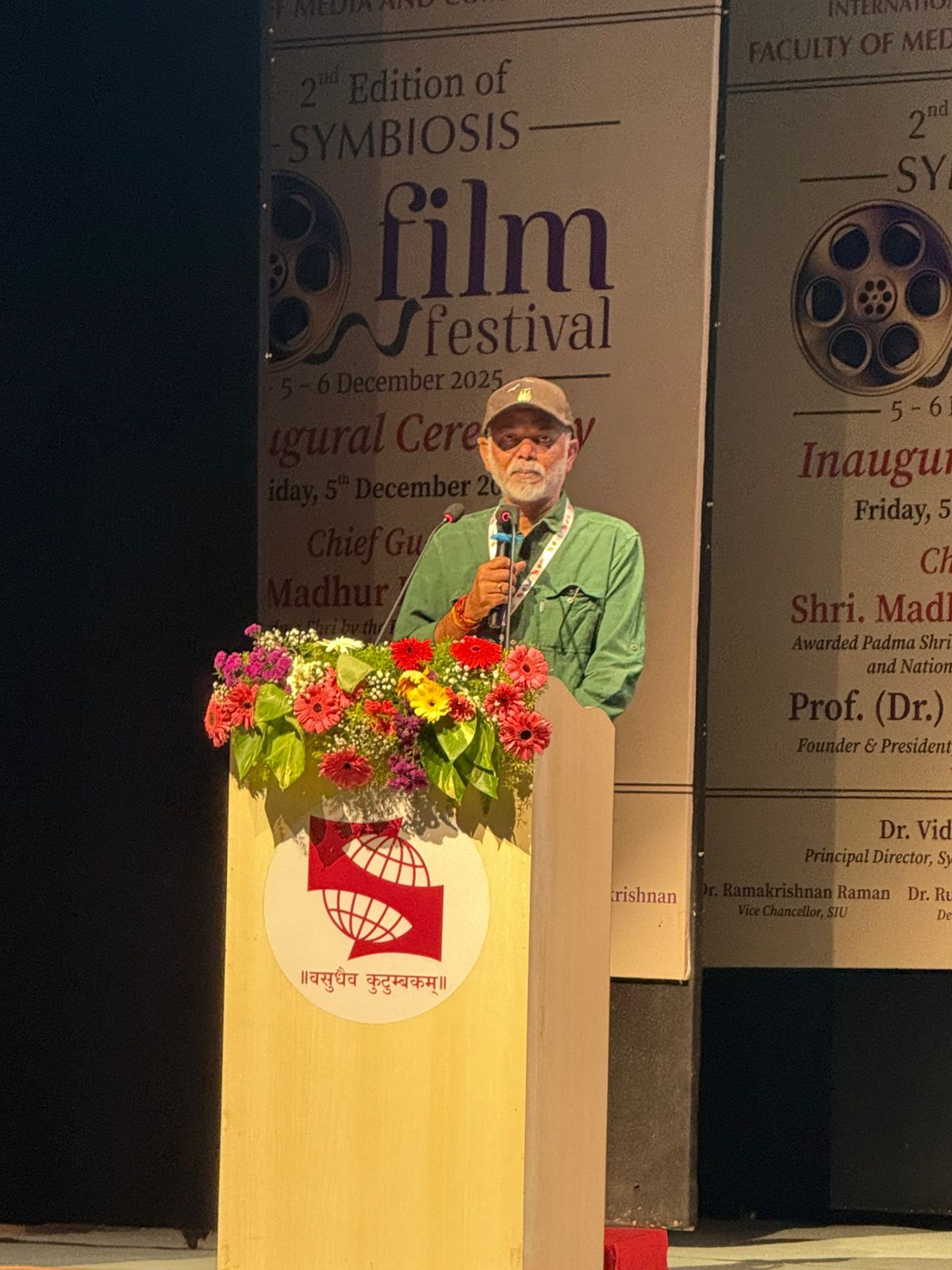
Subbiah Nallamuthu, one of India’s leading wildlife filmmakers, graced the Symbiosis Film Festival 2025 with his remarkable presence. With a career spanning over two decades, he has shot documentaries, feature films, news, corporate films and TV shows. His most prominent works include the tiger documentaries he has shot. His passion for the Royal Bengal Tiger has translated into two international documentaries he has produced, filmed, and directed.
His film, “Tiger Queen”, highlights the clash for dominance in a family of tigers, with the mother tiger, Machli, being ultimately dethroned by her daughter, T-18, after a long tussle. This was broadcast on National Geographic Wild and Animal Planet and was widely acclaimed. Machli was the famous tigress in Ranthambore known for various celebratory names like “Queen Mother of Tigers” and “Lady of the Lakes”. She died in 2016 at 19, which, although longer than the typical lifespan of a tiger, hit Nallamuthu quite hard. He had been following and was closely associated with her for over 7 years.
In the masterclass he spoke about and emphasised the struggles of a freelance filmmaker. He discussed that because of budget constraints, he had limited equipment and was a one-man team–from scripting, to storyboarding and finally shooting. He managed everything. He also addressed various technical questions regarding the techniques he uses to get close to the tigers, what kind of camera lenses he uses for the films and how the story is so unpredictable and changes every second that it’s difficult to maintain a linear structure. He advised the students to maintain flexibility in their vision as the story progresses and encouraged them to find various angles which can breathe life into a typical wildlife documentary. He has worked for and sold his documentaries to prominent media houses like BBC, Discovery, Channel 4, Animal Planet, Star TV and National Geographic.
Wildlife filmmaking often faces a conundrum–whether it should centre the story on specific animals or should exacerbate the broader ecological narratives. To which Nallamuthu explains that he prefers and recommends young filmmakers engage with personal stories rather than emphasising the environmental implications. He says that if you form a bond with an animal, a specific character, it becomes easier for the audiences to connect and care about the broader ramifications as well. He believes that emotional storytelling takes precedence over everything. It’s important to showcase the animals; the relationships they share with each other and their habitat need to be viewed from a curious lens and not just a scientific one. For now, he continues to champion the art of wildlife filmmaking while empowering the younger generation to explore and examine their own ideas and journeys with the animals.