
Prashant Rao
Teaching Associate, SIMC
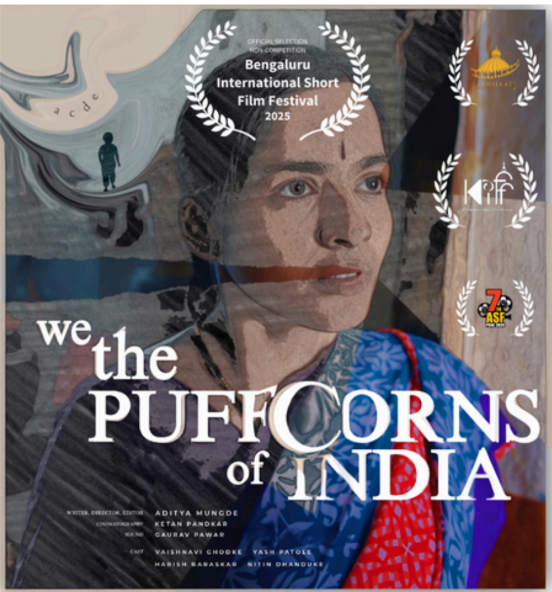
The opening few shots of We, the Puffcorns of India, show the over-the-top, colossal boardings of the god Ram in an absolutely hyper-masculine fashion. Just through these few shots, the director Aditya Mungde sets the tone for the entire film. We see a family of three: the father, the mother and their son. They are planning to leave their village in search of better opportunities due to their land being seized for elections. Discovering his wife’s 10th-grade certificate hidden in their luggage, he starts destroying it with a stone.
The wife, played by Vaishnavi Ghodke, in one of the best performances I saw amongst the films at the Symbiosis Film Festival 2025, retaliates by hitting him, witnessed by their son, who was busy playing a violent video game on his mother’s phone. Within a few minutes, we understand the dynamics which all these family members have with each other and the thematic aspects which the film is going to portray.
The father is convinced by a party member of a political party (never mentioned, but strongly hinted at) to join the Rally march in honour of the consecration of the Ram Mandir, which he agrees to, leaving his wife and their son alone for some time till their bus comes. Next, we see a shot of the rally (shot over an actual rally march; it is astounding how it must have been done, as the logistics of it must have been absolutely insane to manage), in front of a Masjid, portraying a visual dichotomy between the religions.
The film next focuses on the story of the mother, who sees her son act like her father, who is hinted to be slowly radicalised and an abuser. This shocks her as she wants her son to get a great education and prevent him from living the life she is living. Near the bus stop, the mother and the son come across a puffcorn seller, who is selling a variety of puffcorns. This scene contrasts the saffron puffcorns (their natural colour) with colourful, alphabet-shaped puffcorns. Despite her son’s insistence, the mother buys the colourful puffcorns, and the son acts back by using the Rs. 20 he had received from the party member to buy the packet of saffron puffcorn. The director does a brilliant job of using the Saffron puffcorn packet to portray the radicalisation which the son is going through and contrasts it with the mother’s insistence for him to eat the colourful, alphabet-shaped puffcorns, as she wants her son to be educated.
When the father is nowhere to be seen, the mother starts panicking, as the bus has come and is waiting for them. What happens next forms the crux of the film, as it beautifully shows the mother’s resilience and character at probably one of the toughest times in her life.
There is this beautiful shot at the end of the film, which, according to me, perfectly captures the essence of what India should be, and I would like to appreciate the director Aditya Mungde’s brilliant layering and inclusion of themes, interwoven with such simplicity across the film. I had the chance to see the film twice, and on my second viewing, I was able to find so many more things that exemplified my sense of meaning-making of the film.
We, the Puffcorns of India, as absurdly unique as its title is, truly capture the current India’s rhetoric of saffronisation of everyday life. The camerawork is simple, yet effective due to the framing and editing. The screenplay is immaculate and carefully treads the line between being too in-your-face and too obscure; a perfect amount of exposition and information is revealed for the audience to make sense of the story. The very first time I read the title of the film, it intrigued me. But by the end of the film, I came to appreciate how something as mundane as a packet of puffcorn can become a source of hope and send out a very strong, pertinent message on the importance of education.