
By Nityanjali Bulsu
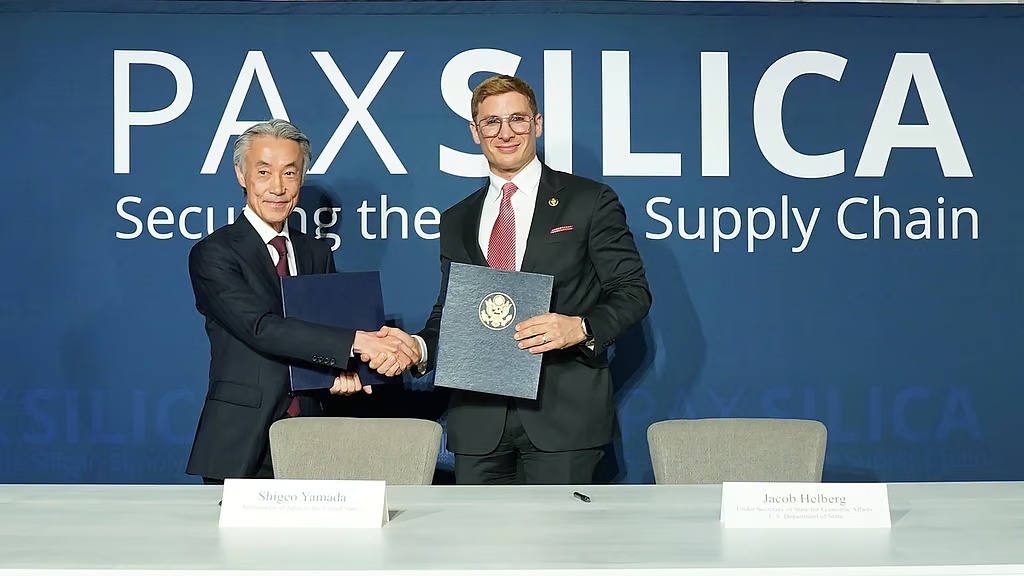
India has been left out of the inaugural grouping of Pax Silica, a new high-technology supply chain initiative. Launched by the United States to build a secure global silicon and artificial intelligence ecosystem, this move has garnered special attention from New Delhi, especially in times when India and the US are negotiating a broader trade agreement to deepen cooperation in fields like technology.
The countries included in the inaugural grouping are Japan, South Korea, Israel, Singapore, the Netherlands, the United Arab Emirates, Australia and the United Kingdom. According to the US State Department, these countries host some of the world’s most important companies and investors across the AI and semiconductor value chain. The initiative covers the entire technology stack, ranging from critical minerals and energy inputs to chip fabrication, advanced manufacturing, data centres, logistics networks and frontier AI models.
Washington has described Pax Silica as a response to growing risks from “coercive dependencies”, referring to China’s dominance in critical minerals and advanced technology supply chains. The framework seeks to promote joint ventures and co-investment, protect sensitive technologies from undue foreign control, and build trusted digital infrastructure, including fibre-optic networks and AI systems. US officials have stressed that the grouping is not meant to isolate any country but rather to create a resilient and secure economic order for the AI era.
India’s absence has stood out, especially given New Delhi’s push to position itself as a global hub for electronics and semiconductor manufacturing. In 2024, India signed an MOU (Memorandum of Understanding) with the US on critical minerals. The countries have also been working together under the initiative on critical and emerging technologies. However, analysts and experts believe that India may not be an obvious end-to-end player in the most advanced segments of the AI and semiconductor supply chain just yet.
Notably, all countries in the Pax Silica grouping have greatly established strengths in different parts of the ecosystem. While India has design capabilities and significant quartz reserves, its processing capacity remains limited. Similar to earlier US-led efforts such as the Minerals Security Partnership, India could still be brought into the fold at a later stage.