
By Tannistha Dey
When we speak of cold, in general, it means either winter or an air-conditioned environment. However, in physics, cold carries a more elaborate definition. Temperature translates to the measurement of motion. If any material or body is cold, it means its atoms are moving less. And when it is at absolute zero, or −273.15° C, its atoms are moving at the least possible rate in nature.
Atoms can never come to a complete stop. This is because quantum theory does not allow atoms to come to a complete stop. However, their motion can come to a bare minimum near a temperature of absolute zero. Over the past several decades, physicists have understood a method by which they can cool atoms to a degree of a billionth above absolute zero.
At higher temperatures, matter consists of atoms interacting through particle-like collisions and elastic bouncing. But as the matter gets cooled, this becomes less true. Its wavelike nature becomes more significant. At very low temperatures, these waves intersect each other, overlapping so much so that quantum effects, which typically lie at microscopic levels, manifest at macroscopic levels.
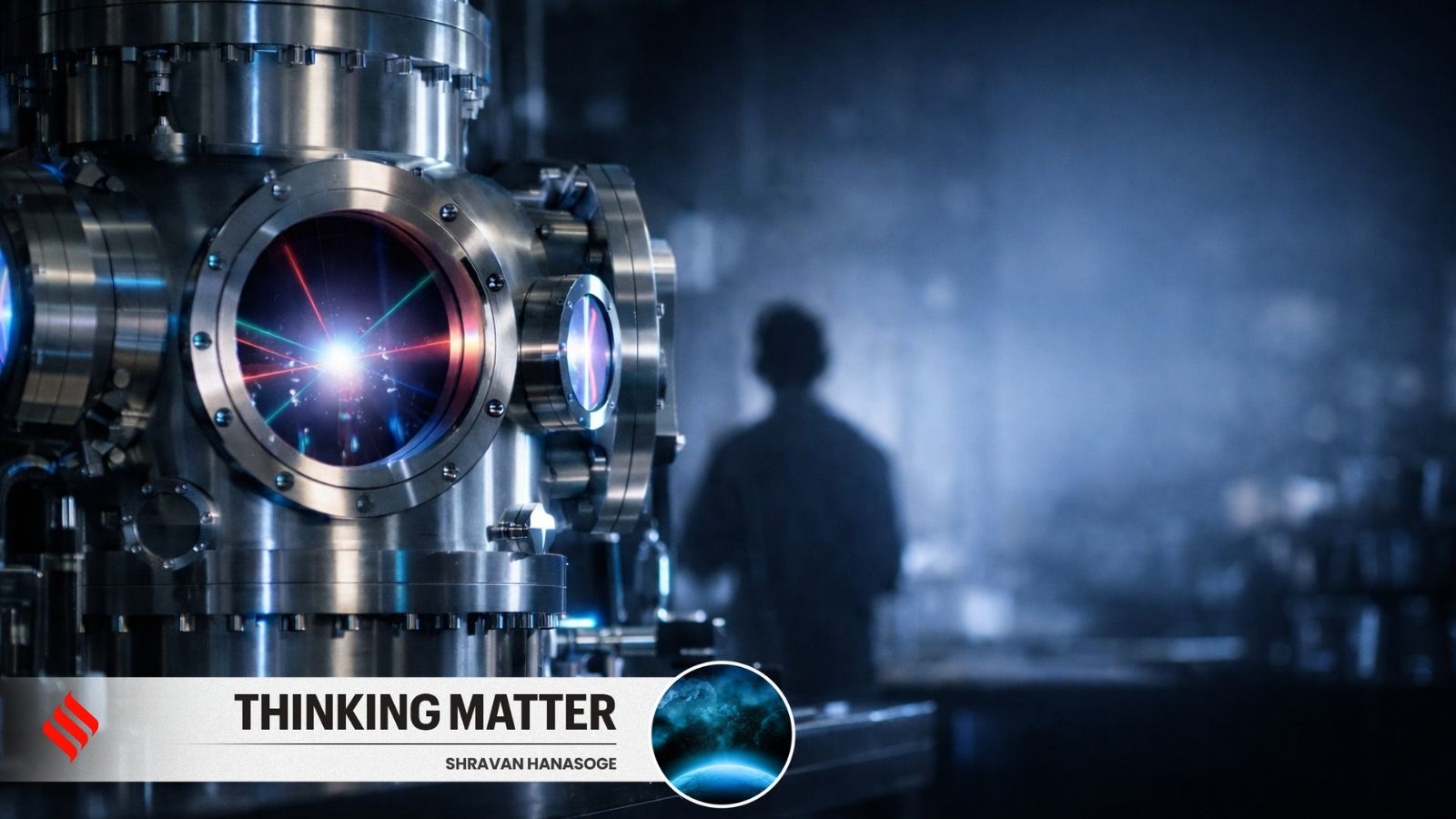
“Cooling the atoms doesn’t mean letting them freeze in one place,” explains Maiko Kozuka of the Riken laboratory. “The method physicists use is laser light. Laser light is commonly linked with heating,” continues Kozuka. “However, light has momentum too. Atoms are given so-called kicks by absorbing and re-emitting light. If laser beams are arranged in such a way that these kicks counteract the movement of the atoms, it’s possible to slow down the atoms in every direction.”
The techniques developed for laser cooling and trapping earned the 1997 Nobel Prize in Physics. By the late 1990s, physicists were able to trap clouds of atoms and cool them to millionths of a degree above absolute zero.
With even lower temperatures, atoms take on a surprising new character. Ordinarily, each atom acts separately. But if cooled sufficiently, their quantum waves begin to overlap. Thousands of atoms then occupy the same quantum state and start to act together. This phase of matter is called a Bose–Einstein condensate.
First predicted by Albert Einstein in the 1920s and created experimentally in 1995, a Bose-Einstein condensate behaves like a single quantum object. The atoms in it can flow without friction, form wave-like patterns, and interfere with themselves. Such properties led to the Nobel Prize in 2001 for creating this new state of matter.
Cold atoms now lie at the heart of a range of crucial technologies: the world’s most accurate atomic clocks-themselves reliant on ultracold atoms-underpin GPS navigation and telecommunications, as well as tests of fundamental physics. At the same time, cold-atom systems are used in sensitive gravity sensors and are emerging as one of the key platforms for quantum simulation and computing.
Matter close to absolute zero can seem inert. Actually, it presents one of the clearest views into how quantum laws shape the physical world, revealed not through heat or energy, but through stillness.