
Dhruvi Shah
The Union Budget 2026-27 introduced by Finance Minister Nirmala Sitharaman on February 01, 2026 has raised the Securities Transaction Tax (STT) on equity Futures & Options (F&O) significantly. This change was made for the purpose of reducing speculative trading and generating extra revenue; however, it has seen a very negative reaction from both financial markets and traders.
The Securities Transaction Tax is a levy that is paid whenever a transaction takes place on any stock exchange in India via tradeable securities (such as shares, stock indices, future contracts and options) as per the recognised stock exchanges list as provided by the Government of India under the Finance Act 2004. The tax was first charged on October 1st, 2004 in accordance with the provisions of the Finance Act 2004 for three purposes: to make it easier for the government to collect taxes on market activities, to discourage tax evasion and to make capital gains tax easier.
Over the years, the STT has become an essential component of India’s overall taxation framework for stock markets in India. Even after the reintroduction of Long Term Capital Gain taxes in 2018 the Securities Transaction Tax has continued to exist.
As per the Budget 2026 announcement made by FM Sitharaman, there have been increases to the STT specific to equity derivatives segments. Below is a list of the changes made:
- STT for Futures Contracts has increased to 0.05% (up from the previous 0.02%)—an increase of 150%
- STT for Options Premium will be revised to 0.15% (up from the previous 0.10%)—representing an increase of 50%
- STT for the Exercise of Options will be revised to 0.15% (up from 0.125%)
Effective Date: 1st April 2026: The changes above will apply for all transactions executed on recognised exchanges and arise due to the government’s belief, as confirmed later by the Income Tax Department, that there has been a significant increase in derivative trading volume in India as compared to the overall GDP of India and that the increased STT is designed to curb speculative action and to minimise the risk of systemic market event failure.
While the percentage increases might seem minimal, the overall effect that is felt by high-frequency and derivative traders will be very large. Futures and options trade on a thin margin and have a very high turnover rate; therefore, even a small increase in transaction costs can have a big impact on the profitability of active traders, hedgers, and arbitrage traders.
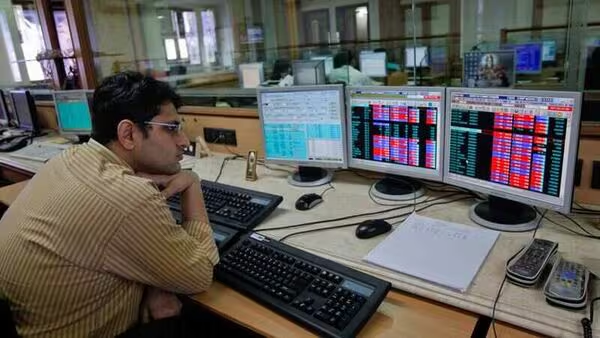
As soon as the Budget was released, investors were shaken by the announcement. The Indian stock indices, like the Sensex and the Nifty50, experienced wild volatility; the stock indices fell during the budget and were still falling the next day after traders had got over the shock of the increased transaction costs and also after traders had considered the potential decrease in liquidity of the derivative markets.
Some of the biggest losers on the day of the budget were broking and exchange stocks. A huge majority of these companies derive their revenue from derivative trading volume, and on the day of the budget, many companies were re-evaluating what their future volumes and margins will be following the increase of the STT. It is very likely that the higher STT will also reduce trading activity, especially among high-frequency traders, speculative traders, and short-term traders, as they are the most sensitive to increases in transaction costs.
As a result, Foreign Portfolio Investors (FPIs) specifically those FPIs who are purely focused on short-term trading or using a derivative strategy—will likely have a much lower competitive position in relation to other emerging market countries due to the fact that higher STT will increase their transaction costs after tax. However, long-only investors who rely on fundamentals will likely be the least negatively impacted by the increase in STT.
The October 2021 Stamp Duty (SBS) increase does not appear to have a significant impact on long-term investors in the equity markets; however, there has been a fundamental shift in policy, excessive speculative trading activity and the management of systemic risks through this increase. There will likely be an adjustment period in the way derivatives are traded and how much liquidity there is in these products while the overall equity ecosystem becomes accustomed to this new tax regime as part of the evolving financial market structure in India.