By Agrim Agrawal
NASA has started a controlled medical evacuation of astronauts from the International Space
Station (ISS), the first ever performed since the complex was integrated into a permanent
habitat for human beings more than 25 years ago. On Thursday, the agency said the four-
person Crew-11 team would phase out their mission and return to Earth “in the coming days”
aboard SpaceX’s Crew Dragon spacecraft following a serious though currently unnamed
medical problem in one of its astronauts. At that same night at the press, NASA
Administrator Jared Isaacman testified that the condition was stable, and that it could not be
reliably diagnosed or treated with the resources on the space station, suggesting the safest
way to get back to Earth early is to do so. Neither astronaut’s identity or details of the
sickness have been shared, in the interest of protecting patient privacy. “This is unique in
crewed spaceflight,” Isaacman said, noting that it’s not an emergency de-orbit maneuver but a
precaution, after speaking with NASA’s chief health and medical officer, Dr. James “JD”
Polk. After scientists announced in August 2025 that NASA astronauts Zena Cardman
(commander) and Mike Fincke (pilot) had joined the team aboard the International Space
Station on a 6- to 8-month mission, experts said, including Kimiya Yui of JAXA and Oleg
Platonov of Roscosmos from the same vessel, on top of a SpaceX Crew Dragon. They were
supposed to return in February 2026 when next ISS crew rotation should land. The health
issue first arose after NASA canceled a planned spacewalk meant to enable the station to
prepare for new solar arrays with its power network because a “medical concern” around one
Crew-11 member was involved. The move caused officials to rethink the mission deadline in
light of the urgency, officials had to respond later. NASA regularly trains astronauts in areas
of emergency medical care, and provides the ISS with numerous powerful health monitoring
systems. But it has fewer resources than terrestrial hospitals, Dr. Polk said. “We have a pretty
heavy-duty suite of medical hardware you can put on board,” he said, “but certainly not the
full kit you find in an emergency room.” With Crew-11 not working next time, the station
will have a skeleton crew before starting the next rotation but research can be delayed
because it cannot do so due to a smaller staff. NASA and SpaceX are also discussing whether
to launch Crew-12, due for launch in mid-February. Since its establishment in 2000, the ISS
,a landmark of global scientific cooperation in space has for decades borne the footprint of
humanity. But at a scale never dreamed of though after decades treating health issues tied to
the microgravity environment, such as flight associated discomfort and light injuries there has
been no real medical evacuation from orbit anywhere.
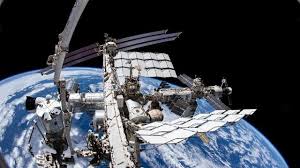 NASA’s International Space Station in orbit, photographed during a Crew
Dragon fly-around after undocking.
NASA’s International Space Station in orbit, photographed during a Crew
Dragon fly-around after undocking. 