
By Sunita D
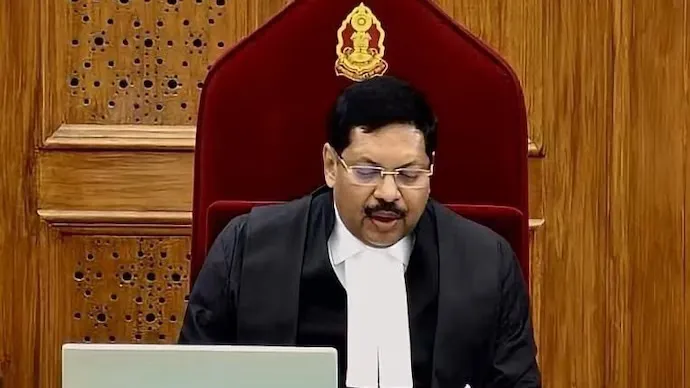
Chief Justice of India Bhushan Ramkrishna Gavai suggested the establishment of a central agency to scrutinize appeals filed by the government in order to reduce the number of pending cases before the court.
A Directive for Efficient Litigation Management’s April document revealed the union government alone has nearly 700,000 cases pending before the court, state administrative tribunals are likely to have at least as much, and state-owned companies will add further to these numbers.
While addressing the 10th All India Conference of the Central Administrative Tribunal (CAT) today, Justice Gavai referred to his regime in the Nagpur bench of the Bombay High Court and recalled, “Certain directions were issued to appoint nodal officers in every department and collector office to filter whether the matter/case deserved to be appealed. Such a filter helped reduce pendency.”
Furthermore, he called out the central government for being the biggest entity before both the Supreme and High Courts. Their appeals are often filed even after concurrent findings of the High Court and CAT. “The bureaucrats are afraid to take risks, and as a result, they pass on the burden to the judiciary. Hence, filtration is required. And the central government continues to be the biggest litigant before the Supreme Court and High Court,” Gavai said.
Supporting Justice Gavai’s suggestion, Union Law Minister Arjun Ram Meghwal also slammed the government department’s practice of filing appeals as a matter of routine even when the tribunal orders were legally sound. He said, “This tendency of automatic appeals must be addressed.”
While emphasising citizens’ right to appeal being a key element of justice, Justice Gavai pointed out that the litigation spanning years eventually undermines the purpose of establishing tribunals. Many government officers reach retirement before their cases are even resolved; this creates significant personal & professional challenges.
He concluded with a hope that these suggestions will help improve the trust for tribunals in the eyes of people. with a hope that these suggestions will help improve the trust for tribunals in the eyes of people.