
By Sunita D
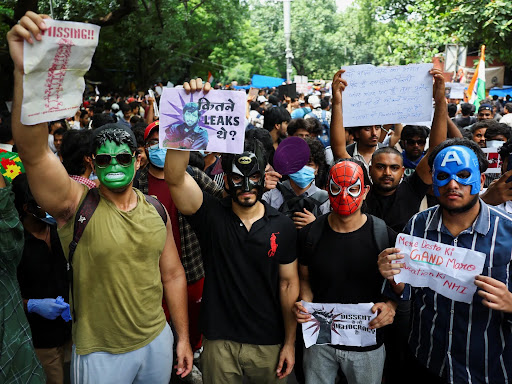
Thousands of protestors stood shoulder to shoulder, their placards rising above the crowd. A student adjusts her mask before joining the march. Another raises a fist as cameras flash from every direction. But not every lens belonged to the media.
While protestors raised their voice to seek accountability, unseen systems run by authorities kept watch over them.
Over the past decade, government agencies in more than 78 countries, including Australia and Russia, have used public facial recognition systems, according to data gathered by Steven Feldstein, a researcher at the Carnegie Endowment for International Peace. During the recent student protests in India, the use of AI-assisted facial recognition vans such as Ikshana and DP-Drishti by the Delhi Police added India to that list.
The Automated Facial Recognition System (AFRS), a tool authorised in 2018 in the Sadhan Haldar v. Delhi High Court case for tracking and reuniting missing children, is now being used for mass surveillance of protestors without legal authorisation.
Pramod Pawar, Senior Police Inspector at Shivaji Park Police Station, said, “The surveillance vans during student protest in Mumbai were used in the public interest to ensure law and order. Footage gathered from the CCTV camera in that area will only be used if any case of crime emerges.”
The Mumbai protest saw a citywide network of fixed cameras linked to centralised control rooms for automated tracking of protestors and post-event investigations. In Delhi, police reportedly used the DP-Drishti and Ikshana vans instead.
The Ikshana van uses high-definition 360-degree telescopic cameras to capture live video feeds of crowds. Its onboard AI software detects faces in real time, converts facial geometry into digital templates, and compares them against existing law enforcement databases to find matches. The van also carries an Automatic Number Plate Recognition (ANPR) system, which scans and records vehicle registration numbers passing through or parked near protest zones.
DP-Drishti (Delhi Police – Dynamic Real-time Identification and Surveillance for Human Tracking Initiative) is a high-tech mobile surveillance vehicle deployed by the Delhi Police for real-time facial recognition and crowd monitoring in crowded public spaces and sensitive zones.
“AI also can find groups. Tools like Geotab can track real-time vehicular and asset GPS coordinates. Through link mapping, AI can find out who talks to who to map out social circles and tight communities,” said Harsh Rangwani, scientist at Adobe Research.
In India, surveillance began to increase after the BJP came to power in 2014, with CCTV cameras becoming increasingly common in cities. But the recent student protests marked a turning point. A key concern is the disproportionate use of facial recognition on minorities.
“Minorities were a little worried about surveillance as they don’t feel safe enough with the communal hate people in power have been spreading,” said Snehal Pabale, a 23-year-old protestor from Mumbai.
Rishabh Mantoo, a Gen Z protestor at the site, said, “I believe surveillance is required to ensure that no one causes any sort of distress at a protest site. It can also work as a proof of evidence for the innocent, if they are detained for any wrong doing that they haven’t done.”
Governments have a legitimate duty to protect participants and investigate serious offences. But there is a difference between investigating wrongdoing and treating an entire assembly as an investigative dataset.