
By Sagarika Rastogi
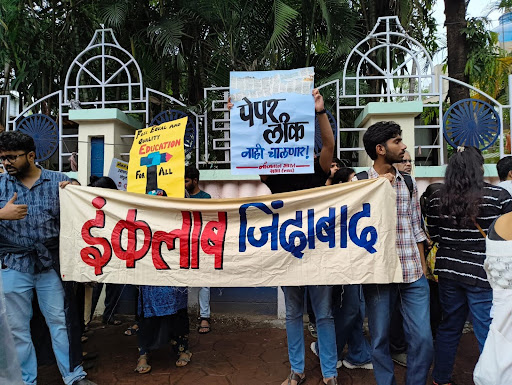
Amidst heavy rainfall on July 20, a weekday, near the Collector’s Office, a swarm of people gathered, angry and agitated, demanding the resignation of Union Education Minister Dharmendra Pradhan. People from all over the city were united over one cause. There were school students who had come after their classes ended, grandparents who had brought their grandchildren in the hope of fighting for a better future for them, activists, and college students.
Posters bearing the images of Bhagat Singh, Gandhi and Dr. B.R. Ambedkar were held by protestors, young and old, demanding accountability from the government over the National Eligibility cum Entrance Test (NEET) paper leak earlier this year. Protestors waved the deep red communist flag, chanted slogans of “Jai Bhim,” and criticised the government’s unresponsiveness and careless attitude toward the paper leak.
In the weeks leading up to July 24, when the march took place, Pune had already seen five to six protests in support of the Cockroach Janata Party’s demands, organised by independent groups. A few of those earlier demonstrations were marked by visible friction, a fact noted by many protestors tracking the new developments around the CJP protests.
Tasneem Bandukwala, a 21-year-old protester, said, “The division in the entire protest was palpable. It felt as if there were two protests happening at the same time. There were slogans in different languages, one group was chanting slogans in Marathi, another raised theirs in Hindi.”
Another protester, Rhythm, who has been in the activism and organising space in Pune for over five years, said, “There were a lot of people. We did not expect so many of them to show up. Because of the strength of the people, it got separated into two. I did not see any disagreement happening between the different groups there. It could be because I was in the back, so I am not sure if something similar took place. However, these movements usually are not just limited to a particular issue. Rather when the cause gains momentum, different groups try to bring forward their issues as well, they could be related to labour reforms or queer rights or anything else.”
“I hated being there. It felt like a publicity stunt. Instead of supporting the movement, different groups were trying to take the credit for being the one who led it,” said Rohini Sridharan, a protester present at the Collector’s Office.
Despite an unmistakable tension in the air during the previous protests over who gets credit for leading the demonstrations in Pune, the organisers had different things to say.
One group present at the different protest sites was Naujawan Bharat Sabha. Ravishankar, who has been part of the NBS for over four years, said, “No individual or political group has tried to hijack the movement. The cause was bigger than our individual politics.” When asked about the altercation between NBS members and the organisers of the protest at the Collector’s Office, he denied that any such event took place.
He said, “sometimes the crowd gets unmanageable and other groups step in to help the organisers so the entire burden doesn’t fall on them.”
The united front was seen at the march that began from Shaniwar Wada and ended at the Collector’s Office. According to estimates, 15,000 to 20,000 people showed up, with around 200 volunteers from different contingents. Organisers included people from different groups and political parties, including Archana Shah Bhivre Patil, Mahila Pradesh Secretary, Congress (Pune); Rushikesh Kanvte, Chief Coordinator of Rayat Vidyarthi Parishad; Aniket Deshmane; Harshvardhan Patil; and others.
Rushikesh said, “Since the demonstrations that took place at Bal Gandharva Chowk and the Collector’s Office on July 19 and July 20, respectively, did not create much of an impact, there was a need for all the leaders of prominent parties and established student groups in Maharashtra to organise something big.”
When Archana was asked why Congress did not join the previous protests held in Pune, she said, “CJP has done amazing work and the movement has been a wonderful success. However, at Jantar Mantar, they had made certain remarks that discouraged the Congress to join the protest. We joined the cause after July 20, because we could not bear to see the brutality inflicted on the students and we believed that it is time to set our differences aside. This is for our youth’s future and all of us need to speak up.”
Despite the organisers denying any possibility of friction, protesters’ experiences told a different story. Eventually, though, differences were set aside for the march, which became one of the biggest and most successful demonstrations Pune has seen in recent years.