
By Salonee Kulkarni
A fifteen-year-old minor girl was sexually assaulted in Bhosari, Pune, on 24th September, 2020, by the immediate neighbour, who has been undertrial since his arrest on 25th September 2020 on the staircase of the house where the accused resides under IPC section 354, currently Bharatiya Nyaya Sanhita (BNS), and POCSO sections 8 and 12.
The accused was present at the relative’s house, where, under the pretext of sweet chocolate, the accused took the survivor away. The accused forcibly kissed the survivor, causing physical and psychological harm. The survivor was at her relative’s house because of a birthday. The survivor was frightened and refused to confront her close family member. Trust and assistance, and confrontation by the father helped the incident be reported at the police station. The survivor reported to the nearest police station in Pune. The arrest was conducted on the grounds of the grave nature of the crime concerning children and the possibility of the accused running away if not arrested, and the distress caused to the survivor and family members.
The reasons for remand have been filed in the chargesheet, citing evidence against the accused which is yet to be collected. Investigation is pending regarding whether anyone incited the accused to commit the crime, and the details regarding the manner in which the accused, on account of sweets, lured the young survivor are yet to be investigated.
A prolonged delay in what is supposed to be a fast-track judicial mechanism to hear high-priority cases to provide speedy justice is witnessing a crack in its mechanism.
On average, 200 to 220 cases are registered under the POCSO Act. It has been three years since the BNS came into effect and fourteen years since the POCSO Act was passed. However, a change in the name alone can not ensure a wider impact that curbs the horrendous crime, causing grievance to a child physically and psychologically.
69,191 cases were registered under POCSO as per NCRB reports in 2024. 5.8% of crimes against children witnessed a rise. 98% of girls were victims of sexual assault. The victims who reported were usually in the age bracket of sixteen to eighteen years.
What is the POCSO Act?
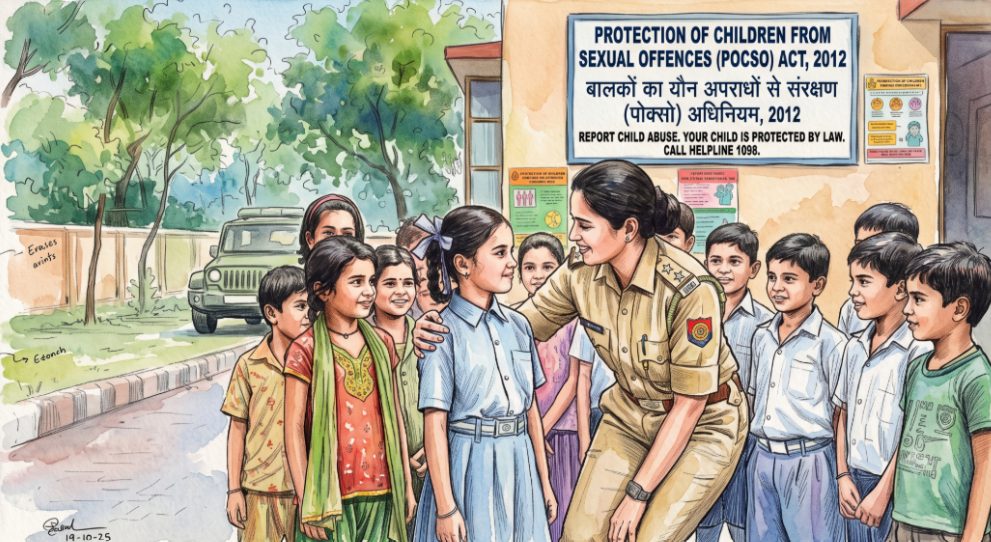
The enactment of this law was to protect children from sexual assault, sexual harassment, and pornographic violations. Special courts have been established to conduct trials. Between 411 and 418, POCSO courts were established and are functional to ensure speedy justice. In 2019, the Act was amended to ensure stringent punishments and to increase the imprisonment period based on the gravity of the offence. In cases of aggravated penetrative sexual assault, the death penalty can be imposed. The punishment has been increased from seven years to ten years. In the case of penetrative sexual assault, twenty years of imprisonment and a fine.
The Act clearly states the child “as any person below the age of eighteen,” which is a step towards Gender neutrality. A person who is in charge of an institution is expected to report the crime; in case of non-disclosure, even by subordinates results in punishment. Children are excluded. Under this Act, a person can lodge a complaint even beyond the time frame when the crime was committed. The Act allows the survivor to register/report the crime. Media organisations must maintain the confidentiality of the survivor unless and until the special courts are authorised to do so.
“The POCSO Act provides a provision under the normal Criminal Procedure Code,” quoted Varadraj Patil, a practising lawyer who graduated from Indian Law School, ILS Pune. The CrPC has been renamed as Bharatiya Nagrik Suraksha Sanhita. CrPC stands as the baseline to follow the criminal procedure applicable to POCSO.
Under the POCSO mandate to record the statement, it is mandatory that the child must be present at their home while recording the statement. Under Section 24, “When a statement is taken, it should be taken by a female officer,” quoted Varadraj Patil.
It is an obligation of an adult, according to the country’s system, to report a child who is suspected of being abused. In the case of a failure to report such incidents, an individual can face six months in jail and a fine or both. When a person who is in charge of a company or an institution fails to report a crime which was committed by a subordinate, the person will be imprisoned for a year and will be fined.
The safety and security of the child under the Act is inclusive of all public spaces, institutions and homes. Since children spend most of their daytime environment in school, the implementation becomes essential. The teaching and non-teaching staff are mandated to follow their duties and take the necessary steps to ensure child safety.
POCSO in Rural areas
However, a grim reality shadows the possibility of justice in rural India. It has been fourteen years since the implementation of the Act, yet schools in rural India are not completely aware of the implications of the Act and its relevance.
“In rural areas, you will find fewer cases are reported due to shame and perceived stain on family honour”, quoted Varadraj Patil.
The surge in POCSO cases in rural India has witnessed a rise over the couple of years. The Maharashtra State Commission for Protection of Children Rights registered 271 cases in rural areas in Pune, reported by Hindustan times. 5,394 crimes against children were recorded in Gujarat in 2024. The figure has been consistently climbing over the past five years, with the overall increase nearing 32% reported by The New Indian Express.
In a rural area in Mundra, Gujarat, a school has implemented POCSO, yet it struggles with successful implementation. POCSO Act in rural areas is equated to corporal punishment. A sense of hesitancy to talk about sexual abuse or even use the term hinders the process of reporting, trust and burdens the child with guilt that does not belong to the innocent heart.
“Fear should exist. POCSO is a good system implemented. The management in the school handles the matter by speaking to the student, parent and teacher. When a teacher is recruited, the teacher signs a bond which ensures that they will not engage in unlawful activity. If caught, the management asks for a resignation. Most of the cases are solved within the school. The school records of the teachers are checked as well. When a situation escalates, the police are called,” said Mohinder S. Masin, the principal of the school.
To bring change at a fundamental level, it is necessary to make students aware of the law in a language a child understands and deliver workshops to identify the wrong and report to a trusted adult.
“The teachers and health care workers from the government come to the school to conduct the sessions and workshops for good touch and bad touch. However, sessions are not conducted to explain the POCSO Act to students and how it helps them. Just as fire safety training sessions are conducted, health workshops and physical fitness tests are conducted similarly; it is necessary to explain the law to students in a way they understand,” said Rekha, founder of the school.