
By Shivli Singh
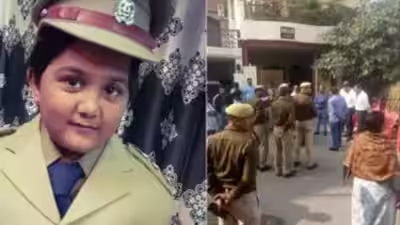
At 5.30 on a November morning, most of Lucknow was still asleep. The shops were shut, the roads were quiet, and the winter sun had not yet appeared. Outside Janeshwar Mishra Park, 10-year-old Namish Krishna Srivastava was out for his regular skating practice.
A few metres away, inside a white SUV, speed had allegedly become a competition. Police claimed that two young men were taking turns behind the wheel, trying to discover how fast the vehicle could go. Moments later, the SUV struck Namish. The child who had come to practise balancing on wheels was left lying on the road.
Namish, the only son of Additional Superintendent of Police Shweta Srivastava, was rushed to hospital but could not be saved. His mother was walking alongside him when the collision took place in Lucknow’s Gomti Nagar Extension on November 21, 2023.
For one family, an ordinary morning ended before the city had properly begun its day.
Police arrested Sarthak Singh, then a law student, and his friend Devshri Verma. According to investigators, the two had taken turns driving the SUV at high speed. Police alleged that Verma challenged Sarthak to cross 150 kmph before Sarthak lost control of the vehicle and hit the child.
The crash left behind a question that cannot be answered by simply calling it an “accident”: when a person deliberately drives at a dangerously high speed on a city road, is the resulting death merely negligence, or does it become a more serious crime?
Police booked the accused under Sections 304 and 279 of the Indian Penal Code, relating to culpable homicide not amounting to murder and rash driving on a public road. The application of Section 304 indicated that investigators viewed the conduct as something potentially graver than ordinary carelessness.
Practising lawyer Divyansh Singh said the case would depend on whether the prosecution could prove that the driver understood the deadly risk involved and continued regardless.
“The law does not need to prove that the driver wanted to kill the child. The real question is whether he knew that driving at such an extreme speed could take someone’s life. If that knowledge is established through CCTV footage, forensic evidence and witness statements, the act may go beyond simple negligence,” Singh said.
The difference may sound technical, but it can determine both the nature of the charge and the punishment. Negligence suggests a failure to exercise reasonable care. Culpable homicide involves a higher degree of responsibility — an allegation that someone acted despite knowing that the consequences could be fatal.
However, an accusation is not a conviction. What happened on that road must be proved through evidence, not public anger.
Police reportedly examined CCTV footage to identify the SUV and trace the two accused. The investigation later widened when Sarthak’s father, Ravindra Singh, was arrested under Section 201 of the IPC. Police accused him of washing the SUV and hiding it to make evidence disappear. He was subsequently granted bail by a local court, while Sarthak and Verma were initially remanded to judicial custody.
Responding to the case, “I know that a child has lost his life, and no statement can take away the pain his parents are living with. The matter is before the court, and I will cooperate with the proceedings. I hope the complete facts and evidence will be considered before a conclusion is reached.”
His version deserves space because every accused person is presumed innocent until proved guilty. But that principle does not make the family’s loss any less real. A courtroom may eventually decide the extent of criminal responsibility; it cannot return Namish to his parents.
The case also points towards a larger failure. How could an SUV allegedly reach such a speed on an urban road used by children, walkers and cyclists? Where were the speed cameras, patrol teams and traffic-calming barriers? Why do preventive measures so often appear only after somebody has died?
Following the crash, police discussed installing zigzag barricades on roads where speeding had become common. Such barricades may save another life, but they came too late for the little boy outside Janeshwar Mishra Park.
In court, Namish’s final morning will be reduced to footage, forensic reports, speed calculations and provisions of law. Lawyers will debate intention, knowledge and negligence.
For his parents, however, it will remain something far more personal: the morning their only child went out to learn how to balance and never came home.
A speedometer can show how fast a vehicle was moving. The law can decide who must be held responsible. But neither can measure the emptiness left behind in a child’s room.