
By L A Adithya and Shivani P Menon
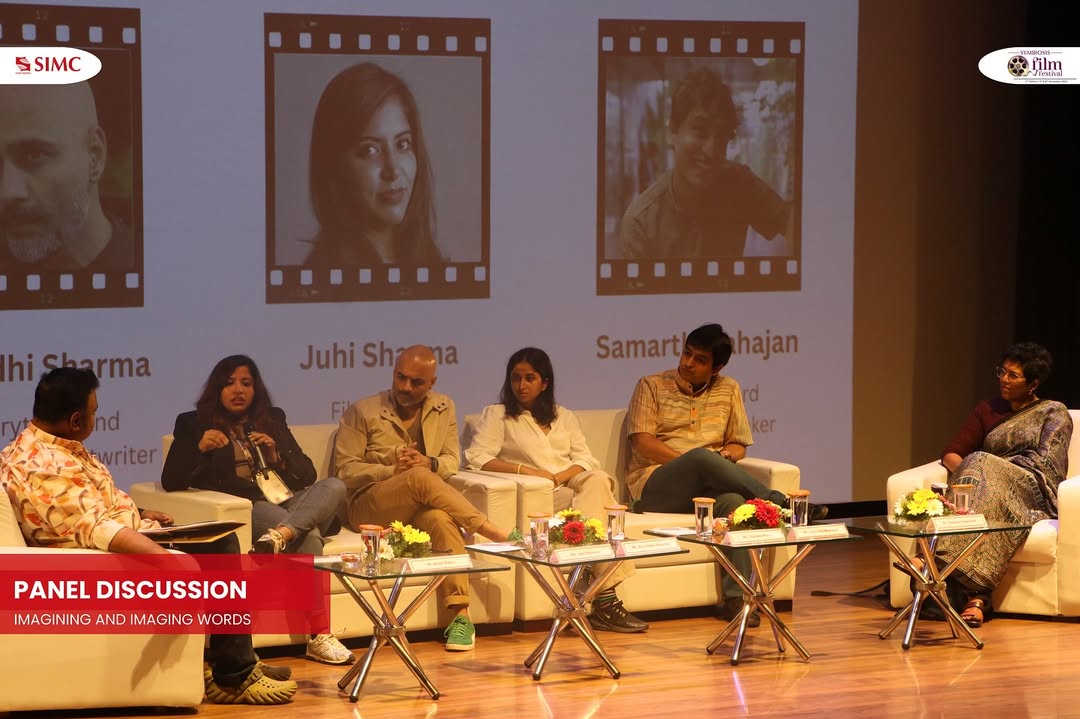
Day 2 of the Symbiosis Film Festival resumed with a lively panel discussion titled “Imagining and Imaging Worlds: Telling Stories in Cinema.” The moderators were Dr Swapna Gopinath and Dr Asjit Datta, who steered an open and honest conversation about how stories take shape on screen. The esteemed members of the panel were Garima Puri, Divy Nidhi Sharma, Samarth Mahajan, and Juhi Sharma.
The conversation kicked off with the challenge of turning “words into worlds”. Garima articulately puts forth the necessity of immersing oneself into the story and having lived experiences in fiction writing, with the socioeconomic landscape also playing a vital role. Poignantly, Juhi points out that cinema and stories are just extensions of whatever is created in the head, be it through overlapping Venn diagrams or character inventories and building a world.
On the follow-up, the poet, Divy Nidhi, explained how tedious yet beautiful the whole process is, while Samarth, on the same lines, related it to Hindi Cinema’s possible redundancies.
From critically choosing stories complementing characters to discussing the research aspects involved in filmmaking, the panel goes on to shed light on some interestingly enriching insights in the domain. Nidhi states something very profound: that research and authenticity are always in a constant tussle. Juhi produces an interesting take as to unearthing “not the symptom but the cause” of things.
When the discussion shifted to scripts, it was emphasised how they keep changing, birthing moments of improvisation and adaptation from live happenings and circumstances during, before, or after the shoot. Samarth further goes on to state how intertwined the lack of objectivity in filmmaking and research are, which is fascinating, to say the least.
The topic of audience satisfaction and filmmaker responsibilities brought about a plethora of perspectives. Juhi firmly states that the moral responsibility of a filmmaker is to bring to light the social issues. Furthermore, all the panellists agreed that filmmaking is a privilege in a country like India, which is why they believe they owe everything to the audience.
Coming to discussing the Indian audience, Nidhi put forth how Indian audiences are perhaps some of the smartest in the world. Concurring with what he said, Ms Garima also spoke about how they do not look down upon their audience, re-emphasising the responsibility the filmmakers bear.
Finally, it almost becomes an eventuality to bring the advent and impact of AI tools into the conversation. Taking more or less an optimistic stance, all the panellists considered AI to serve as tools that assist human creativity, dismissing prophesying anything to its doom. As Mr Nidhi poetically put it, “Until AI learns to fall in love, get its heart broken, and whatnot, it cannot produce anything that is fully human.”
Towards the end of this insightful session, the panellists then moved on to interacting with the students. During the enriching interaction, several points were raised, ranging from biasness in cinema to finding audiences for every niche.
Conclusively, a strong message and valuable advice were shared by the esteemed filmmakers with all the aspiring students of cinema and filmmaking: that ideas and innovation must be furthered through perseverance, resilience, hustle, and truth.