
By Swastika Sahu
By implementing better communication techniques, the Indian government is significantly increasing road safety in the country. Vehicle-to-Vehicle communication technology, which could operate without reliance on any particular country’s network, is what they are intending to install in vehicles. Without the use of mobile networks or the internet, the new system allows drivers in each vehicle to communicate with each other directly, as well as exchange and update safety alerts simultaneously in order to eliminate careless driving mistakes.
The technology is anticipated to be especially useful in avoiding incidents with stationary vehicles and rapidly approaching traffic from the rear. It will also assist in preventing massive collisions during thick fog, a frequent problem in the winter months. Cars equipped with this technology will exchange signals and alert drivers when another vehicle approaches in a hazardous manner.
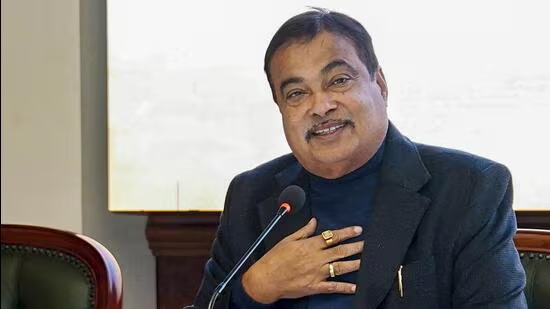
Union Road Transport and Highways Minister Nitin Gadkari gave information on the program after the Annual Meeting with State Road Transport Ministers. He said that the technology will be implemented shortly and that the matter was covered at the previous meeting.
The inter-vehicle communication paradigm known as vehicle-to-vehicle (V2V) communication is not yet commonly diploid and standardized. The primary characteristic of V2V is that it communicates without the use of third-party networks, such as cellular networks. With a 360-degree view of surrounding vehicles, its ad hoc communication range is up to 1000 meters. Even though V2V has many advantages, deployment nevertheless presents a number of difficulties. Interest in this technology has increased as a result of operators’ strong ratings of V2V’s ability to solve road traffic critical safety.
Gadkari said V2V communication will work across the front, hinder and sides of vehicles, and will factor in terrain and road curves, allowing cautions indeed when hazards are hidden from a driver’s line of sight. The technology will be integrated within Advanced motorist Assistance Systems( ADAS), mainly enhancing their effectiveness.
He said the estimated cost of the system would be ₹ 5,000 – ₹ 7,000 per vehicle. The ministry is finalising norms and regulations, after which an announcement will dictate installation in new vehicles first, followed by retrofitting in older vehicles.
Besides V2V, another focus of the government is improving the safety of buses. Fire extinguishers, emergency hammers, and driver drowsiness detectors will all be installed on the current buses as a way of addressing safety associated with the design of buses and previous deadly accidents.