
By L A Adithya
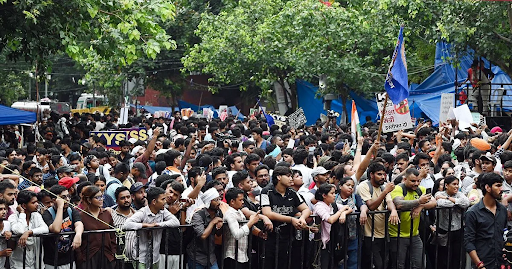
As India’s youth erupted in protest, led by the Cockroach Janata Party (CJP), over the National Eligibility Cum Entrance Test (NEET) paper leak, two parts of the country, Delhi and Bihar, went dark on four occasions in the last 10 days out of 28 this year alone. The government imposed internet shutdowns at protest sites, calling the move necessary “in the interest of public safety and averting public emergency.”
This raises a crucial question about the authorities’ approach to young people exercising their democratic and fundamental right to protest and access the internet. Over the past decade, India has seen a consistent trend in internet suspensions. On the surface, it may look like a method to curb dissent, but the line between public safety concerns and silencing voices is not always clear.
“Sometimes the government has to take extreme measures to maintain public order and ensure everything is under control,” said a protester who did not want to be identified. He said many people at the protest were making content out of the situation and using obscene and inappropriate language.
But there is another side to the story. Naysa Shrivastava, a journalist from the Indian Express who covered the protest, said her team could not send content to their office because there was no internet. Many news organisations worked out of vans, she said, moving inside to file their reports before returning outside to continue covering the protest. With no internet service near Jantar Mantar, rumours and misinformation spread, undercutting the very safety measures the shutdown was meant to achieve.
Internet shutdowns in India are governed by the Telecommunications (Temporary Suspension of Services) Rules, 2024, issued under the Telecommunications Act, 2023. The rules allow suspension of services in cases of public emergency and safety, but a protest alone is not sufficient legal ground for a shutdown. Many see this as a violation of Article 19(1)(a) of the Constitution, which courts have linked to the right to access the internet. While this raises concerns for protesters affected by the shutdown, questions remain about the scale of the protest and its potential to disrupt public order.
“It is a pretty difficult situation for law enforcement agencies to monitor such situations via encrypted messages, because it is not possible to intercept them,” said T. Sridharan, Additional Superintendent of Police and Head of the Branch, Central Bureau of Investigation (CBI). He said monitoring focuses on how traffic moves, from where to where and when, rather than specific data content.
“We expect the government to take care of us. In an egalitarian society, you must allow everybody to use the internet without discrimination,” said political analyst Harish Ramaswamy. He pointed to the Jasmine Movement, the Pink Shady Movement, and similar uprisings in the Arab world, Hong Kong, and elsewhere, noting that many of these movements spread through social media. Any communication that is not live, he said, can be interpreted in damaging ways, and breaks in the flow of information increase the risk that messages get distorted.
India has recorded 930 internet shutdowns since 2012. The numbers rose sharply in 2018, 2019, 2020 and 2021, driven by the abrogation of Article 370, the Citizenship Amendment Act (CAA), and later the violence in Manipur. What emerges from these events is that dialogue and negotiation remain essential to a healthy democracy. Measures like internet shutdowns during youth protests raise pressing questions about government accountability.