
By Tanisha Mohanty
People across the world march, demonstrate, and petition to challenge political authority. In India, they have often fought with raised fists, and empty stomachs.
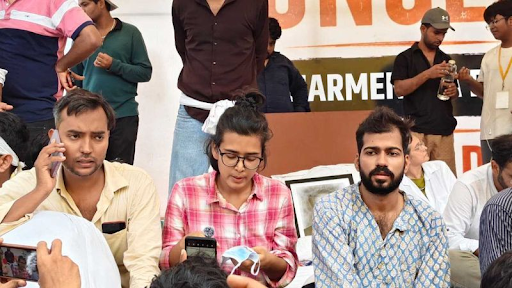
Sonam Wangchuk’s 26-day hunger strike in support of the Cockroach Janta Party (CJP) protests against the NEET paper leak at Jantar Mantar, New Delhi, not only sets a precedent for further student-led agitation and political and educational reforms, but also creates a long-persistent and relevant dialogue between the public and the state, especially in contemporary India.
Wangchuk, who also went on a hunger strike in 2024 in Ladakh in support of statehood and environmental safeguards, motivated six other All India Students’ Association (AISA) members to join him in the protest as well.
This invoked one of the oldest forms of protest, adopted by the likes of Bhagat Singh and Mahatma Gandhi during the freedom struggle, and, in more recent memory, Irom Sharmila and Anna Hazare, among many others.
Yet this also raises a question: in a politically fragile world, do hunger strikes still bring the same form of accountability and responsibility from people in power? Can the government’s and public’s moral and ethical consciousness be influenced by hunger strikes, or is the act merely symbolic in nature?
The 2025 National Eligibility cum Entrance Test (NEET) paper leak was the final nail in the coffin for students and the public at large. The CJP protests emerged to contest irregularities in the education system and the constant paper leaks that have occurred over the years.
Aameen Amitoj, AISA Vice President at Ambedkar University, Delhi, who joined the indefinite hunger strike alongside Wangchuk, recalls, “We had exhausted all possible measures of peaceful protest…The hunger strike was the last step after every other democratic avenue had been tried.”
Manish Kumar, AISA’s Uttar Pradesh President from Allahabad University, also argued that hunger strikes acquire legitimacy precisely because they involve self-sacrifice rather than coercion. With years of campaigning and protesting against examination irregularities with no actual reform, Kumar stated, “Hunger strike is the strongest form of protest…the last option for us.”
Unlike marches or slogans, hunger strikes turn suffering inward; the body and the human being itself become a site of protest. Political analyst Rajendra Chenni notes that the effectiveness of this lies in this moral inversion. Rather than inflicting harm on others, the protester willingly bears the physical and mental cost, which communicates how grave the issue actually is.
“Here is somebody who is not punishing anybody else…he is punishing himself,” he explains, suggesting that this ethical dimension continues to resonate deeply within India’s political imagination.
This moral and ethical standard can be heavily drawn from India’s long political history. Gandhi transformed fasting into a political tool of protest during the freedom struggle; Bhagat Singh’s 116-day hunger strike demanded political prisoners’ rights under colonial rule.
Since then, hunger strikes have been woven into the socio-political consciousness of the Indian people. From Potti Sriramulu’s strike for linguistic reorganisation, to Irom Sharmila’s sixteen-year-long protest against the occupation and the Armed Forces (Special Powers) Act in Manipur, to Anna Hazare’s movement for the anti-corruption Lokpal Bill in 2011, all of these have been pivotal in changing the political landscape of the country. And all of them have been shaped by the public as well: students, the workforce, farmers, labourers, and minorities.
However, there has been a significant change in the manner in which the state responds and takes accountability for the grievances of those affected.
The CJP protest and Wangchuk’s forced hospitalisation are a primary example of this. For Amitoj and Kumar, these interventions reflected less a concern for the “health” of protesters and more an effort to weaken the momentum of the protest. Both argue that removing hunger strikers from these spaces diminishes the visibility that gives the hunger strike its political power.
While accountability from the state and policy change is the main motive of such hunger strikes, Amitoj also said the movement was directed as much towards ordinary citizens as towards those in power. “We were never on a hunger strike to appeal to Mr. Modi,” he says. “We were on a hunger strike to appeal to the people of India.”
Chenni elaborated on how hunger strikes work gradually, by shaping public opinion rather than forcing instantaneous action from the government. Their success lies in creating “the right opinion and the right state of mind,” eventually opening channels of communication between the state and the people.
The CJP protests clearly demonstrate how political influence can extend beyond legislative outcomes. Public mobilisation and renewed conversations around the structural flaws in the existing examination and education system, as well as the NEP policy, are evidence of implications reaching well beyond Jantar Mantar.
The ripple effect of the protests can be seen across states and among different student communities and universities. Kumar describes the resignation of the Education Minister as a “partial victory,” stating that structural reforms are still underway and that the agitation will not stop until the changes are visible and effective.
In an era where digital activism fades within hours, hunger strikes continue to demand attention because they place the body and its deterioration at the centre of political activism. Yet this also reveals the limits of moral politics. It relies heavily on public empathy and the willingness of the government to acknowledge its implications.
The CJP protest clearly highlighted how Gen Z is shaping modern political movements. As Aameen Amitoj put it, “If a 59-year-old man can do it (go on a hunger strike), so can the youngsters.”
The persistence of hunger strikes across generations shows how the practice occupies a unique place within India’s quest for democracy. And while hunger strikes are not unique to India, nowhere else have they occupied such a central place in political activism and the transformation of self-denial into a political tool.