
By Shivani P Menon
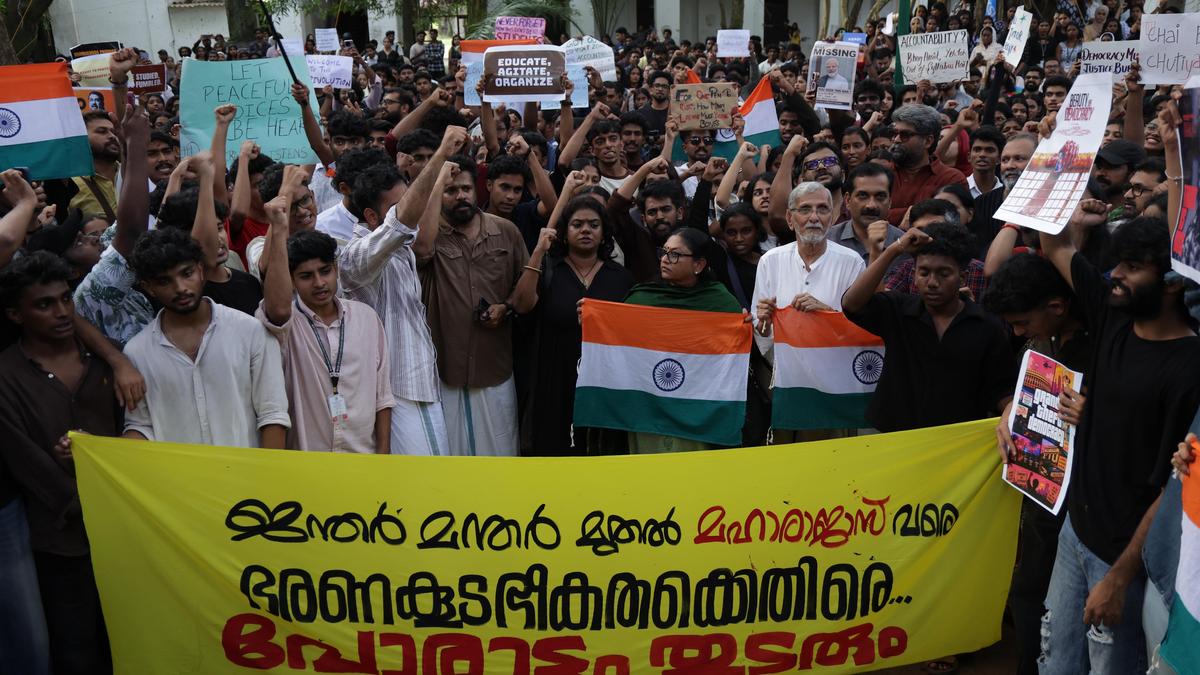
Despite Chief Minister V.D. Satheesan’s participation in the protest at Jantar Mantar in New Delhi, students and organisers involved in the solidarity demonstrations across Kerala said the movement was viewed primarily as an expression of support for students affected by the education system, rather than as a political campaign. Solidarity protests at Maharaja’s College in Kochi and in Kozhikode brought together students, activists, and members of the public, reigniting discussions on student activism and youth participation in public issues.
Organisers of the Kozhikode protest rejected the perception that their demonstration was politically affiliated.
“We did not hold it as a CJP protest. We did not represent anyone other than NEET students suffering from their education system. It was a protest of students, as we have always clearly stated. Our community is one of students, and for students,” said Faheem, one of the coordinators of the protest held in Kozhikode.
Bhadra G.S., a master’s student from Sacred Hearts College who also participated in the protest at Maharaja’s College, Kochi, said students have started to feel that every issue affects them, and that this is why such issues should be considered important.
“Many students no longer think, ‘This issue doesn’t affect us, so it isn’t our concern.’ There is a growing belief that even if a problem does not directly affect us, standing with those who are affected is part of being a responsible society,” she said.
She said her participation was driven by a sense of democratic responsibility and solidarity. “The protests held in colleges and different parts of Kerala showed that the cause extended beyond one city, and that people across the country were willing to raise their voices peacefully for the same issue. This movement demonstrated that protests can have a real impact — developments that followed, including the Education Minister’s resignation, are evidence that public pressure can influence those in positions of authority,” she said.
Asked to describe the gathering, Bhadra said it brought together students, activists, and members of the public. People from different age groups and backgrounds came together to participate. There were students, members of the public, and celebrities, all standing together for the same cause. Faheem said he was amazed to see students from different districts also come to participate in the peaceful protest.
Bhadra said many young people are becoming more aware of the impact politics has on their lives, even if they do not identify with any political party. Referring to a quote attributed to Vladimir Lenin, she said, “If you do not interfere in politics, politics will eventually interfere in your life,” adding that political decisions ultimately affect everyone, and that students therefore have a responsibility to speak up on issues they believe are important.
N. Abdu Raoof, a member of the Kerala Students Union (KSU), said the protests in Kochi lasted two days and were organised as a solidarity event following the Sansad March at Jantar Mantar.
According to Raoof, similar solidarity programmes were organised at Panampilly Nagar and Kacheripady in Kochi, bringing together students, activists, and members of the public. He said he believed the participation of Congress leaders in the Jantar Mantar protest encouraged more students to come forward and raise their voices, while adding that the demonstrations in Kerala remained focused on student concerns.
Both Faheem and Raoof also pointed to social media as an effective means of mobilising participants. Faheem noted that social media, despite its shrinking organic visibility, was instrumental in disseminating information.
Raoof said, “Social media will grow further. Trends and social media increase public awareness and attract more participants.”
Raoof believes protests and social media helped amplify students’ concerns, but said lasting change will require more than public demonstrations. “We can use social media and protests to change people’s thinking, but bringing change to the system as a whole is much more difficult,” he said.