
By Pragati Saha
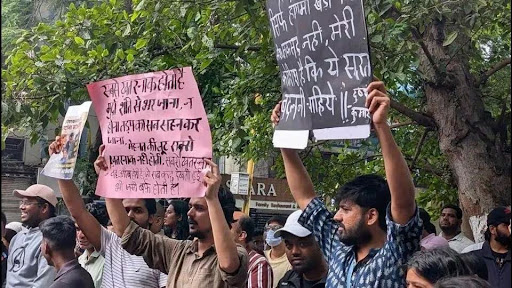
On July 20, 2026, students of the Film and Television Institute of India (FTII), Pune, extended their support to the Cockroach Janta Party (CJP) and activist Sonam Wangchuk’s Sansad Chalo march. Despite being a government institution, the students carried on with the protest, recalling the paper leak in their own college’s entrance exam.
The students gathered on the college campus, demanding the resignation of Union Education Minister Dharmendra Pradhan following the NEET-UG paper leak.
The CJP protest had initially begun on June 6, 2026, at Jantar Mantar, New Delhi. It later spread across the country, growing into a grassroots movement in India. At FTII Pune, the protest was organised by Nishant Kabir, a student at the college.
In the wake of the NEET-UG paper leak, students recalled the paper leak in FTII’s own entrance exam. Speaking on this, Shreshtha Kovvali, Documentation Secretary, FTIISA, 23rd Batch, Screenwriting Department, said, “In the 2024–25 FTII entrance test, the FTII administration, due to a supposed clerical error, released wrongly marked merit lists. Once the matter was raised by affected candidates, they were compelled to release another merit list and increase the intake of students by nine seats. That may not seem like much, but in as small an institution as this, it leads to much higher utilisation of resources and difficulty in accommodation.”
Apart from the 2024–25 FTII entrance exam issue, the 2025–26 FTII entrance exam paper was also so poorly planned that it led to a leak. The exam also started nearly an hour late at a few centres across the country. Initially, the FTII administration planned to conduct a re-examination only in New Delhi, where there was extensive documentation of the chaos following the disastrous planning, and where rumours of a paper leak had also surfaced.
After the FTII Students’ Association (FTIISA) compiled and shared proof and testimonies from various test centres across the country, along with administration members who were investigating the leak, the college had no choice but to conduct a re-examination across the entire country. Apart from this, no other major investigation has been carried out by FTII to identify the source of the leak. A notice posted by FTII on the matter can also be found on its website.
Asked what exactly prompted them to extend solidarity to Delhi’s hunger strike, he said, “FTII has, over just the past ten years, undergone a series of changes with regard to its syllabus and schedule — in 2015, with the adoption of the CBCS, and then in 2025, with its affiliation to the UGC.”
Shreshtha Kovvali also added, “Not to mention, the ever-evolving nature of film tech and film theory means a subsequent and constant dialectic on film pedagogy itself. We are no strangers to a broken system that is constantly collapsing in on itself in order to fix itself. However, the last ten years specifically have been challenging due to the socio-political landscape in the country.”
The Film and Television Institute of India Students’ Association (FTIISA) has also criticised the way the central government handled the protest. According to the students, the government should have held a peaceful conversation with students regarding their demand for Union Education Minister Dharmendra Pradhan’s resignation, rather than deploying police force.
He also added, “The FTII community has always tried to be a space of resistance to the ever-privatising and opaque education system, and will always extend solidarity to students like us who are simply demanding a more just, equitable and inclusive education.”
After a call to the office of Vice-Chancellor Shri Dhiraj Singh, an email was also sent to him regarding the same, but there has been no response from his side so far.
The original NEET-UG exam was conducted on May 3, 2026. It was later cancelled following paper leak allegations. A re-examination was subsequently conducted by the National Testing Agency on June 21, 2026.
According to FTII students, the paper leak crisis is no longer confined to a few pockets of the country — it has now become a nationwide problem.