
By Salonee Kulkarni
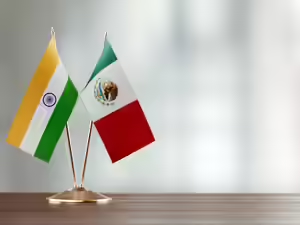
On Thursday, the Mexican Senate approved the imposition of 50% tariff on Asian countries. India has been impacted by the tariff imposition, especially in the car trade. The effect on the car trade will come into effect in 2026.
Mexico has imposed a trade tariff on countries that did not sign the free trade agreement for the last two years. $5.7 billion worth of goods were exported in 2024-2025. It accounted for 1.3% of the total exports.
Mexico has imposed the new tariff to raise $52 billion in estimated pesos to increase revenue. Mexico relies on other countries for manufacturing inputs. The rise in tariffs is estimated to increase fuel prices.
China has called out Mexico’s practice of unilateralism and protectionism. Mexico’s tariff imposition is similar to that of the US tariff policy on China. Some analysts have discussed how limiting the deepening ties with China will mitigate the trade tensions with the US. The analysis comes to light due to the United States-Mexico-Canada Agreement (USMCA) review in 2026. The agreement review is held every six years. Officials have claimed that the imposition of tariffs ensures that Mexico can leverage its own market against Asian imports without relying heavily on import dependence.
The car industry, which includes prominent companies like Volkswagen, Hyundai, Nissan and Maruti Suzuki, will be at a disadvantage because the import tariff being levied is at 50%. VW, Hyundai and Suzuki addressed a letter to India’s Commerce Ministry regarding the impact of the tariff and urged assistance from the Government.
Due to tariffs, the automobile industry will have to redraw the map of its business strategies. Indian companies rely on exports to ensure that production is maximised through economies of scale, to boost profit margins, and to ensure that domestic sales are slow.
A larger impact can be observed on the restructuring of the supply chain due to the imposition of tariffs. A shift in the market will be noticed from Mexico to other destinations. Trade policy and negotiation can lead to the possible mitigation of tariffs. Emerging categories of industries will find a competitive market. The impact has a value of immediacy, impacting the automobile and intermediate goods. In the long term, factors such as responses to policy, the global trade environment and bilateral talks with Mexico will determine the country’s emphasis on protecting its nation from exposure to foreign policy implementation on domestic markets or an integration policy ensuring that globalisation policy and relations with Mexico are sustained on a trade front.