
By Dhruvi Shah
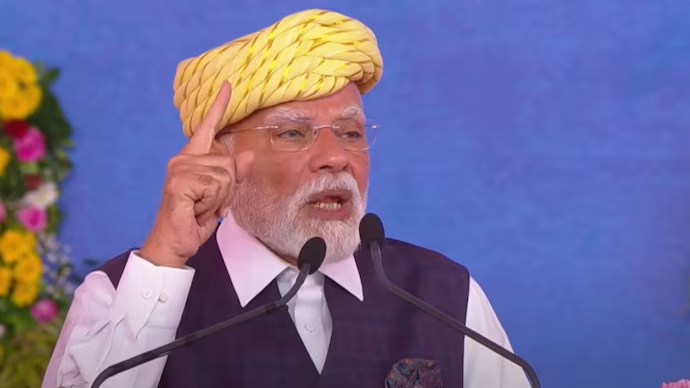
Prime Minister Narendra Modi said on Saturday that India’s biggest challenge was not a “friendly nation” but “dependence on others” for essentials and technology. In a public programme in Bhavnagar, Gujarat, he cautioned that dependence was India’s “biggest enemy” and that society needed to “speed up the movement towards self-reliance” in everything ranging from semiconductors to shipbuilding.
“If we face any real adversary today, it is not another country but our dependence on foreign powers. This is the enemy we need to destroy,” Modi told the audience, reinforcing the philosophy of Atmanirbhar Bharat (self-reliant India). Modi said that decreasing dependence on foreign actors was required for both economic growth and the maintenance of India’s dignity in a public forum.
These comments come at a time when there is tension in trade relations with the US. On September 21, the United States announced a $100,000 fee for H-1B visa applications, claiming that outsourcing costs the American worker jobs and is a national security issue. The US order has caused alarm in India because they send hundreds of doctors and other professionals to the US every year.
The visa action follows another controversial action by the US – steep tariffs on Indian imports. President Donald Trump justified the action by falsely linking India’s continued purchasing of Russian Crude oil to funding the Russian invasion of Ukraine. The Biden administration believes that it can pressure New Delhi by applying economic pressure to sever its energy ties to Russia, despite Prime Minister Modi indicating that India wishes to diversify its energy sources.
To Modi, these actions illustrate the need to accelerate domestic capacity. He justified self-reliance, or “atmnirbhar” as known in India, not as isolationism but instead as resilience in a world of chaos at a time of changing geopolitics: “India must stand on its own feet – only then will we be able to protect our interests and our self-respect.”