
By Tannistha Dey
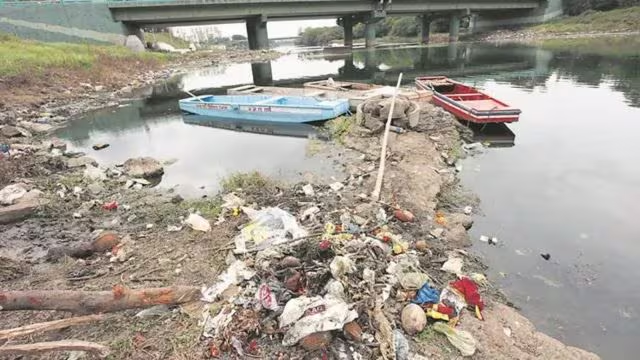
India’s rivers mostly remain under serious stress, with only a small decrease in the number of polluted stretches across the country. The latest review by the Central Pollution Control Board (CPCB) shows that polluted stretches dropped from 311 to 296, but the overall picture is still grim. Maharashtra continues to top the list, with 54 stretches of rivers officially marked as polluted.
The CPCB’s findings are based on water quality data collected from over 2,000 monitoring stations across 271 rivers in 32 states and union territories. The previous study, which used data from 2019 and 2021, has flagged 311 polluted stretches.
A “polluted stretch” basically means parts of rivers where the water quality has fallen below safe standards. The CPCB uses BOD to measure pollution. Rivers are polluted if BOD is over 3 mg/L. If BOD is over 30 mg/L, they are priority 1 polluted. BOD levels under 3 mg/L are safe for bathing.
Recently, 37 stretches were listed as priority 1. Last time, it was 46. This means more rivers have priority 1 levels. These stretches are in 14 states. Rivers in Tamil Nadu, Uttar Pradesh and Uttarakhand are the worst among all the states. Gujarat has four such stretches, and Karnataka has three.
But the report also highlighted areas where water quality has really worsened. These include stretches of the Jhelum in Jammu and Kashmir, the Ganga, Ramrekha, and Sikrahna in Bihar, the Hasdeo and Mahanadi in Chhattisgarh, the Sal and Mapusa in Goa, the Kaveri and Tungabhadra in Karnataka, the Periyar in Kerala, the Amba in Telangana, and the Kosi in Uttarakhand.
The National Green Tribunal (NGT) had, as far back as 2018, conducted both the Centre and state governments to make detailed river rejuvenation plans after reviewing CPCB’s findings. In reply, committees were set up to draft action plans for protecting rivers.
The CPCB has urged for higher management of river basins and floodplains, better sewage treatment before it enters rivers, and stronger protection of catchment areas.
Currently, India supervises water quality at 2,155 locations across 645 rivers under the National Water Quality Monitoring Programme, a joint effort of the CPCB and state pollution control boards.