
By Srijita Chakraborty
A group from the Pune Institute of Computer Technology (PICT) won first place in the Indian Space Research Organization’s (ISRO) renowned robotics competition, Fly Me on Mars, in a remarkable triumph for student-led creativity. ISRO’s U R Rao Satellite Centre (URSC) hosted the event and challenged participants to design and exhibit autonomous flying systems capable of operating in Martian conditions, where conventional aids such as GPS and magnetic compasses cannot be relied upon.
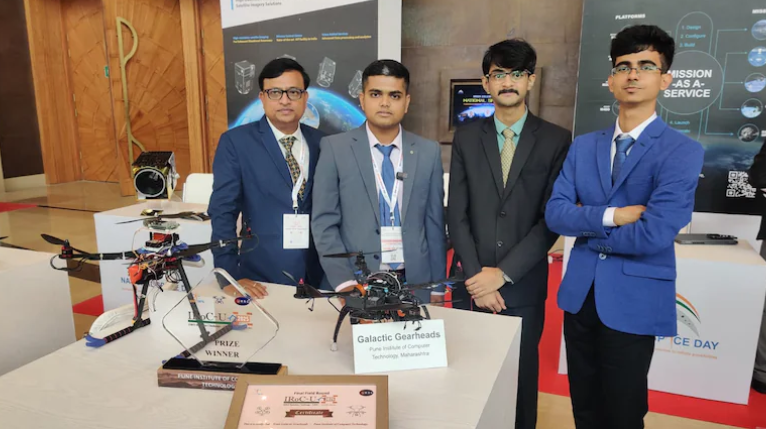
The winning team Galactic Gearheads consisted of students Hrushikesh Patwardhan, Nimish Satav, and Kaushal Chaudhari and worked under the mentorship of Dr. Sandeep Gaikwad. Their 1.7 kg drone was notable for meeting ISRO’s stringent weight requirement of less than 2 kg while exhibiting exceptional autonomy performance.
The goal was to replicate actual Martian-like exploration situations. Their drone was able to perform autonomous tasks like vertical takeoff, hover, safe landing, and return to base without the assistance of an external navigation system. The team built a 9×12 meter Martian terrain simulator beforehand at their college campus in order to thoroughly test sensor integrations and algorithms in a controlled environment. Their design included LiDAR-based terrain mapping and optical flow algorithms for visual navigation.
Galactic Gearheads were the overall winners out of 16 shortlisted finalists from all over India. Their achievement not only demonstrates the talent among Indian students, but also the potential of indigenous solutions to space technology issues.
Their success not only shows the ability among Indian students, but also the capabilities of local solutions to space technology problems. The students’ success could be compared to the tale of the Ingenuity helicopter of NASA, the first device to make a flight on Mars, and which was built under the direction of Dr. Bob Balaram, an Indian-origin scientist. His groundbreaking effort paved the way for subsequent aerial exploration of the red planet by demonstrating the possibility of controlled flight within Mars’ atmosphere.
ISRO, which set history ablaze with its Mars Orbiter Mission (Mangalyaan) in 2013, is already conceptualizing ambitious follow-up missions, a potential soft landing on Mars among them. Systems like the one developed by the PICT team could potentially find a place in such missions, providing indigenous technological backbone to planetary exploration addressing practical engineering problems associated with space missions. Competitions like these develop the future space scientists and engineers by linking classroom training with state-of-the-art applications.
As India sets its sights on further interplanetary exploration, the success of the Galactic Gearheads serves as a strong reminder that the most ambitious visions for the future of spaceflight are already underway in university labs.