
By Salonee Kulkarni
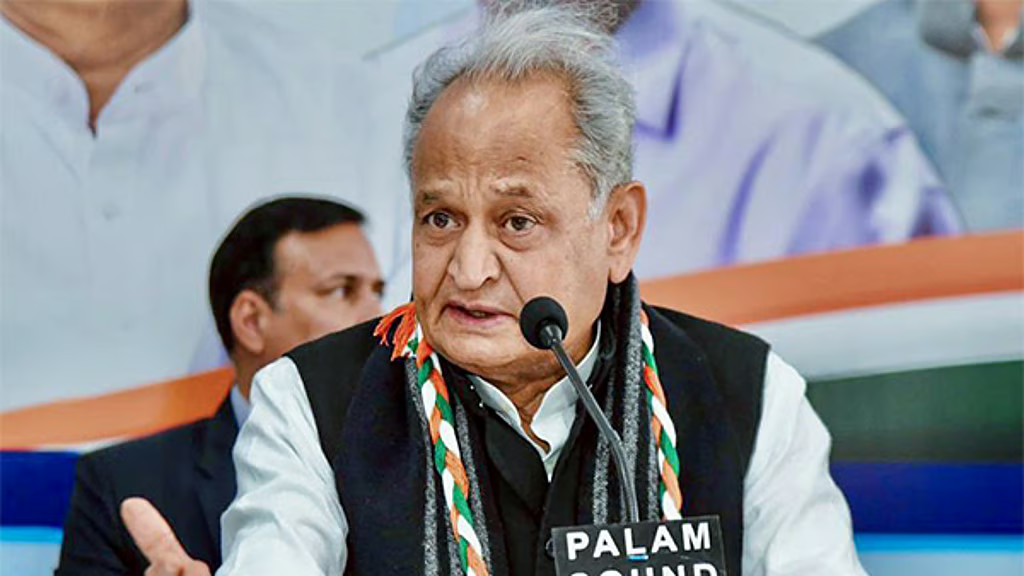
Ashok Ghelot had joined the protests related to the recent Supreme Court ruling related to the Aravalli ranges, stating that mountains below the height of 100 meters will no longer be considered mountains.
The Supreme Court decision received heavy backlash and criticism. The decision sparked protests and drew criticism from citizens living in Rajasthan, who are the primary victims of the decision, which will result in large-scale ecological damage. Ashok Ghelot stated that the decision to decide what constitutes a mountain in the Aravalli region will signal a green light for illegal mining and environmental destruction.
According to Ashok Ghelot’s belief, most of the mountains in the Aravalli ranges are below 100 metres, roughly comprising 90% of the total hills. Due to which the judgment is a death sentence for the region, according to Ashok Ghelot.
The Aravalli ranges are a shield for Rajasthan. Its removal hampers the ecosystem and invites environmental degradation. Ghelot added that the removal of the ranges could exacerbate the water crisis.
The Aravalli ranges stretch from Gujarat to Delhi and pass through the Indian states of Haryana, Rajasthan, and Gujarat. The mountain ranges are the oldest and act as a critical ecological spine, protecting the states against desertification and serving as a barrier against the expansion of the Thar Desert. The Aravalli ranges ensure biodiversity conservation, climate regulation, and groundwater recharge. The Aravalli ranges are rich in minerals like limestone, marble, sandstone, copper, zinc, and tungsten. Three rivers: Chambal, Sabarmati, and Luni are important in the region.
Unfettered mining as a result of the Supreme Court’s judgement will inflict wounds on future generations, which history will never forgive, Ghelot added. Further adding that the Supreme Court should reconsider its decision to prevent ecological damage impacting future generations.
Tikaram Jully, from the opposition party in the Rajasthan Assembly, condemned and criticised the move, stating that livelihoods will be lost if the Aravalli ranges cease to exist. She questioned the future of Rajasthan and believed it was at stake. She demanded answers from the Central Government and the Union Ministry of Environment and Forests.
Further adding, it is not a political party’s sole responsibility to raise a voice against the Aravalli Ranges ecosystem destruction, but equally the responsibility of society collectively to take measures to save the state and the ranges. Furthermore, the government in power promises to implement ecological and sustainable development projects, but the irony lies in the false democratic principles, wherein the government expedites the process of ecological destruction.