
By Tasneem Bandukwala
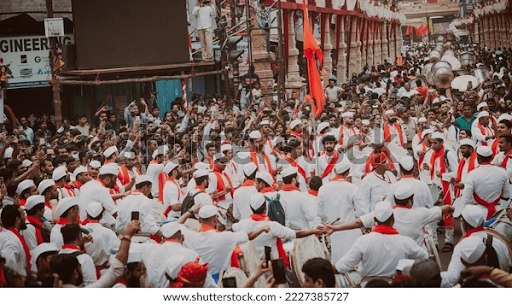
Every year, as Ganeshutsav approaches, Pune turns into a rehearsal ground. Walk through the lanes in the heart of the city, and vibrations and loud rhythms fill the air. From school playgrounds to housing society lawns, hundreds of dhol tasha pathaks in Pune tune their drums for the ten days that define the city’s cultural calendar. But behind the rhythm lies a story of caste, community, and, increasingly, political money.
For many participants, that spirit of unity is what continues to draw them in. “I belong to a lower backward caste, but there was always something in me that loved Ganpati a lot. It is the unity of people that brought me to Ganpati,” said Pranav, who has participated in dhol tasha for several years.
The modern dhol tasha pathak traces its origin to the 1980s, when Appasaheb Pendse formalised what had been scattered, informal drumming into a disciplined art form. He introduced uniform dress codes and choreographed formations.
The tradition itself stems from Ganeshutsav’s founding purpose. Lokmanya Tilak had turned the festival into a public, community event during the freedom struggle, using it to bring people of every class and caste together under British rule. Today, Pune is home to an estimated 150 to 200 pathaks, drawing in children as young as 10, students, and even NRIs and foreign nationals who return each year just to drum.
“There is no religious barrier when it comes to Ganpati. There is a Muslim in our pathak, but he too believes in the unity that Ganpati brings,” said Pranav.
That sense of a space where caste and religion recede behind a shared community spirit is part of why these pathaks hold such deep resonance in the city. But this is precisely the appeal that has made pathaks attractive to a very different set of people: politicians.
Ganeshutsav in Pune is one of the largest, most visible gatherings in the city, drawing lakhs of devotees onto the streets during visarjan processions that sometimes go on for over 24 hours. For politicians and parties looking to build visibility ahead of elections, that kind of footfall is difficult to manufacture through any other means.
“Politicians often have to spend a lot of money to campaign and come into the public eye, so these dhol tasha pathaks during Ganpati visarjan become a great opportunity for them to gain visibility,” said a resident who has attended the Ganpati visarjan processions for years.
A well-known example of this is Manikchand Oxyrich, the bottled water brand under the Manikchand Group, which has for years been visibly associated with Pune’s Ganpati mandals and dhol tasha events through its sponsorship activities, lending the company the same public halo that comes with backing a beloved cultural institution.
According to the pathak member, this dynamic intensifies sharply around election season. “If elections are around the corner, the parties will fund these pathaks a lot more, because it helps them associate their image with a highly celebrated festival,” he said.
What makes the funding arrangement more than a simple sponsorship, according to another pathak member, is the informal exclusivity it demands. Mandals that accept funding from one party are often expected not to accept funding from any other, and, allegedly, the consequences of crossing that line can be serious.
“A lot of mandals get money from one party, and that means they cannot then take funding from any other party. If they get caught, sometimes there can be a police case,” the pathak member alleged.
While such claims are difficult to independently verify, since party funding of mandals and pathaks is often done through informal channels, the perception itself is telling. It suggests that within Pune’s dhol tasha ecosystem, financial backing from political parties is common.
However, one dhol tasha pathak organiser said his group is fully funded by the money it collects through charity during the processions. He claimed that even though they have 450 to 500 participants every year, they take no money from any political party.