
By Dhruvi Shah
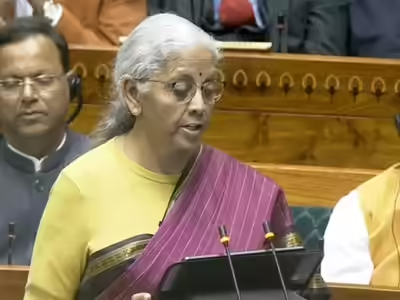
The Union Budget for the financial year 2026/27 was presented by Finance Minister Nirmala Sitharaman. The Government of India announced many initiatives that will use tourism as a means of boosting economic growth, employment, and global competitiveness to help facilitate this vision. The Union Government has mixed together components of infrastructure-building, heritage-conserving, skill-enhancing, and policy-reforming for both international and domestic tourism markets in its budget.
A large investment in connectivity for the tourism market comes in the form of seven new high-speed rail corridors connecting regions of major metropolitan area activity across India The high-speed rail corridors will assist with increased passenger mobility while decreasing the time that passengers spend travelling. The rail corridors also contribute to providing sustainable transportation. This new high-speed rail corridor network will connect several major economic corridors with many cultural and recreational destinations that are hoped to lead to significantly increased tourism activity and regional economic impact (especially hospitality, travel and other travel-related businesses).
The government will be developing 15 archaeological and cultural sites into vibrant experiential tourism sites in an effort to further promote cultural tourism. The sites include many internationally significant locations such as Sarnath, Rakhigarhi, Dholavira, Lothal and Leh Palace.
Enhancing infrastructure (developing enhanced visitor facilities), developing immersive storytelling capabilities, establishing interpretation centres and developing community-supported walkways at these sites will increase visitor engagement and preserve these valuable sites. The establishment of these experiential tourism locations is part of India’s goal of becoming a “heritage tourism superpower”.
In recognition of the skill gaps in the tourism and hospitality industry, the budget has allocated funds to develop a National Institute of Hospitality through the upgrading of the existing National Council for Hotel Management and Catering Technology. The National Institute of Hospitality will serve to connect academia, industry and government in order to improve professional quality in the hospitality industry.
Additionally, the Government is investing in the establishment of a pilot project to develop a workforce of 10,000 guides across 20 iconic tourist locations. The guides will be trained in a hybrid training delivery model with the intention of providing a better experience for visitors while simultaneously creating job opportunities for local citizens.
A Sustainable Development Plan emphasises the promotion and the establishment of Nature Based Tourism opportunities. This includes providing guidelines for the establishment of ecologically sustainable trekking and hiking corridors in Himachal Pradesh, Uttarakhand and Jammu & Kashmir, as well as along the Eastern Ghats (Araku Valley) and the Western Ghats (Pothigai Malai).
In addition to cultural/ecological initiatives, the government has proposed to establish five regional tourism hubs that will be developed in partnership with state governments and the private sector. These hubs will also include circuits designed for medical tourism, healthcare, and travel.
The overall budget promotes travel internationally, providing a more conducive environment for the Indian population to participate in international education, healthcare, and tourism markets. The budget has rationalised the TCS on international tour packages and foreign remittances to 2%. Therefore, international travel should be more accessible to the general population of India.
The establishment of a National Destination Digital Knowledge Grid is also being established to digitalise all national cultural, spiritual, and heritage assets, which will support better planning, marketing and event management for visitors.