
By Dhruvi Shah
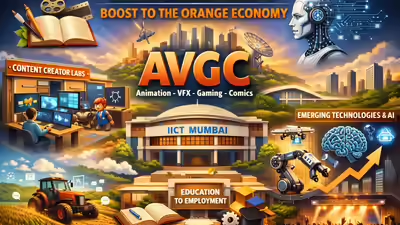
The Union Budget of 2026–27 places a strong focus on India’s growing Orange Economy. The Animation, Visual Effects, Gaming and Comics (AVGC) sector has a lot of potential for job creation and growth within the global marketplace, so the government has committed to providing substantial support for developing skilled talent and building the necessary infrastructure to support future job creation, with a goal of creating approximately 2 million jobs by 2030.
The Orange Economy refers to industries driven by creativity and culture, including industries that produce content such as animation, gaming, film, visual effects, digital storytelling and design, while utilising new forms of intellectual property. The AVGC market is one of the fastest growing sectors of creative industries across all countries, created by rising levels of digital consumption, an increasing level of demand for global outsourcing and the advancing use of technology, such as artificial intelligence and immersive media.
AVGC Sector: A Major Source of Job Creation
Based on the Budget speech, the AVGC sector will require an estimated total of nearly 2 million skilled professionals by the conclusion of the decade; therefore, it has significant potential to contribute to the overall employment rate of youth in India. In addition, the AVGC sector offers a variety of career opportunities within the sector, including roles such as animators, game designers, VFX artists, script writers, sound designers, software developers and digital content managers.
The government is committed to nurturing the domestic talent pool required to take advantage of this opportunity by creating focused interventions aimed at establishing a robust pipeline of talent from school through higher education.
AVGC Content Creator Labs (CCL) in Schools and Colleges
Among the many major initiatives included in the Orange Economy program is the establishment of AVGC CCLs in all corners of the country; specifically under this initiative, the government will partner with the Indian Institute of Creative Technologies (IICT), Mumbai, to create:
• AVGC CCLs in 15,000 high schools
• AVGC CCLs in 500 colleges
The goal of these labs is to provide students with early access to creative technologies including animation, gaming, visual effects, digital storytelling and similar forms of creativity through technology, to allow them to develop applicable skills for going into industry at a young age.
Students will learn to use advanced technology and software through hands-on training in state-of-the-art facility labs. This learning style will provide a more practical approach to training for students to obtain more potential when entering the workforce by helping build their skills to stimulate innovation and entrepreneurship within the creative industries.
Matching Skills to the Needs of Industry
According to the Finance Minister, the Budget is about creating an operating environment, and therefore jobs, that will allow India to better position itself as a high-value creator instead of just a low-cost service provider, as well as being a global centre for high-value creative content. Through the process of incorporating AVGC education into both mainstream education (K-12) and later education (post-secondary), the government is working to close the gap between industry-demanded skills and education-produced skills.
This area of work aligns with the larger objectives of Digital India, Skill India and Make in India. The AVGC industry will continue to grow through its contribution to export and global partnerships as well as to create intellectual properties.
The AVGC industry in India has already created major partnerships with most international film and video game companies. With structured skill training, early talent development, and institutional support, the Orange Sector will enhance India’s ability to compete in the global creative economy and provide long-term employment for Indian workers.