
By – Dhruvi Shah
On 1 February 2026, Ms Nirmala Sitharaman, the Union Minister of Finance (the Minister), announced her 2026-2027 Union Budget. Minister Sitharaman’s primary purpose for presenting this year’s budget is to provide a series of programmes to grow the Indian economy because of high tariffs placed on many Indian exports to the U.S.A. and the ongoing decrease in global trade. The government has decided to take a strategic approach to enhancing India’s export competitiveness this year via the budget. This is being accomplished by decreasing the costs of exporting, increasing the manufacturing output of Indian manufacturers, and overall creating a more effective trading environment. This will allow India to continue to grow as an economy, despite the challenges presented by other countries.
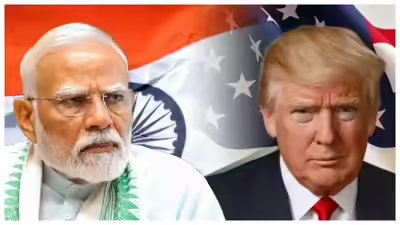
The basis of these proposed measures is that the United States has imposed considerable tariffs on a number of items produced in India, including textiles, leather, and manufactured products that require a large amount of labour. The impact of these tariffs is significant because the United States is considered to be one of India’s principal trading partners and as a result, the tariffs placed on these products have negatively impacted India’s economy. The budget contains immediate and long-term solutions to the tariffs in order to enhance India’s competitive ability in the marketplace compared with other countries when exporting products outside of India.
The most substantial change contained within the 2026-27 budget is a revised customs duty and tariff framework. Included within the proposed budget is a proposed simplification of the customs tariff structure along with proposed exemptions from duty on the materials used in production of goods that are exported from India. An example is the duty-free import of goods for production, including fish and other processed products for exportation. As the value of goods exported will be less due to the elimination of customs duties on inputs required within the manufacturing process, the cost of producing goods within India will continue to remain competitive, particularly with respect to textiles.
The Budget 2026 has introduced comprehensive Duty Concessions for Intermediate & Input providers of the labour-intensive sectors exporting from India, thereby helping to ease the immediate cost pressures on those exporters while enabling them to maintain their export volumes at an acceptable level. The introduction of this policy is part of a larger initiative by the Indian Government to align their customs regulations with the changing nature of international trade and thereby enhance the competitive advantage of firms based in India competing globally.
The Government of India recognises the importance of Special Economic zones (SEZ) by including provisions in the Budget for allowing them to sell to the Domestic Tariff area ( DTA) at discounted duty rates, as a one-time concession only. By providing this temporary concession, the Government of India is attempting to maintain the full utilisation of production capacity in SEZs even though global demand for various products may change due to tariff restrictions, thereby guarding against job losses in India and ensuring that SEZs can maintain their level of operations during an international trade shock.
In addition to tariff reductions, Budget 2026 includes significant investments in the strengthening of India’s domestic manufacturing base. Significant programmes such as the PLI (Production-Linked Incentives) programme and support for Manufacturing in Electronics & Textiles, along with significant investments in Infrastructure are designed to reduce India’s reliance on imports as well as to expand India’s production capacity for products ready for export. In this way, the Government of India is attempting to reduce the vulnerability that India has to international trading shocks arising from tariff changes by diversifying the markets for Export, with a focus on producing products using processes which produce a substantially higher value added than today’s values.
Fiscal discipline continues as a principal theme, with the government maintaining an equilibrium between a targeted relief programme and keeping broad macroeconomic stability. The 2026 Union Budget addresses immediate tariff issues by supporting an indication of sustained economic growth and supporting domestic demand through continuing to increase public capital expenditure in critical areas such as infrastructure and industrial clusters.
As noted, the 2026 Union Budget’s efforts to respond to the recent tariffs levied by the U.S. do not exist in isolation of one another; rather, these measures align with India’s broader trade/economy strategy of reducing the risk to India’s growth from global unilateral pressures. Through various initiatives regarding customs reform, exporting support programmes and incentives for manufacturing activity, India continues to maintain its competitiveness in a disorganised global economy through protection of its exporting sector.
To summarise, the 2026 Union Budget provides India with the means of preparing to respond to external tariff shocks and support its export/importing community while enhancing their domestic economy through both immediate short-term and longer-term economic strategies through the implementation of practical fiscal and structural tools.