
By Rohini Sridharan
Tamil Nadu will remember the tenth of May, 2026. That day saw the emergence of a new chief minister, C. Joseph Vijay, a leader who is not a part of the Dravidian duopoly ecosystem. Tamil Nadu and its people witnessed a new political wave, but whether this new political shift has come with an economic cost is a question that is still unanswered.
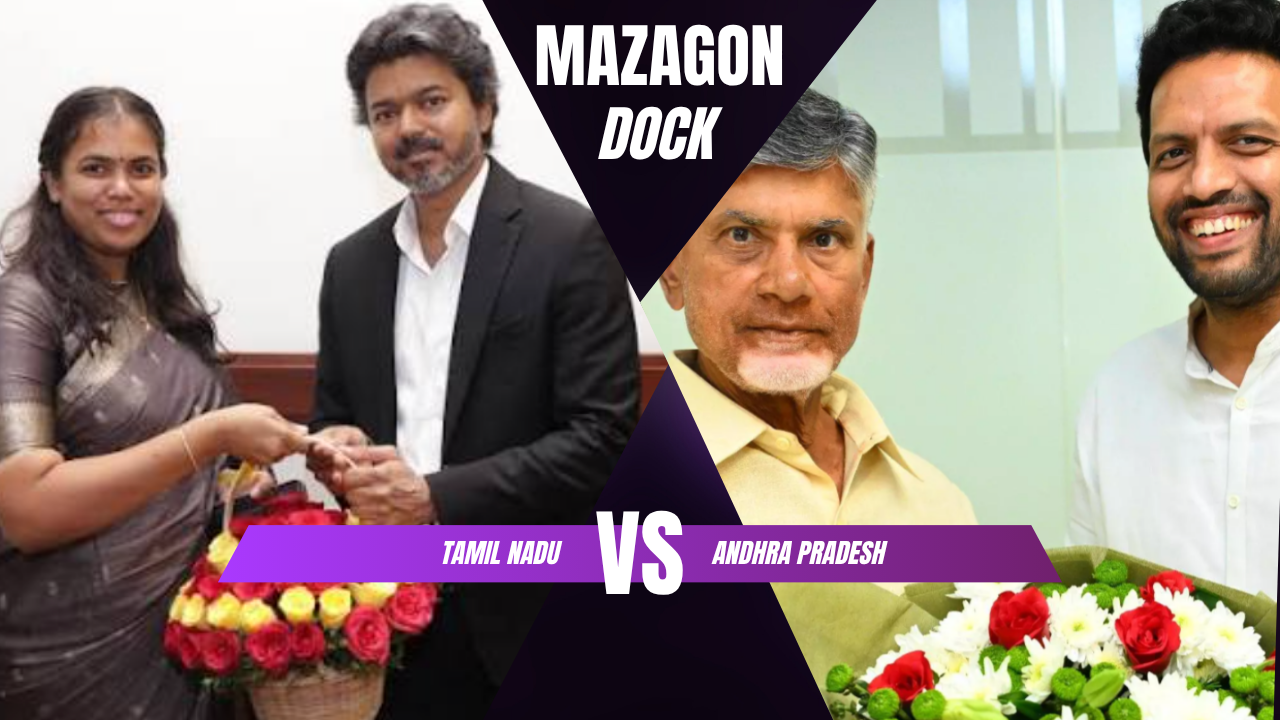
India’s leading defence shipyard, Mazagon Dock Shipbuilders Limited (MDL), recently announced its investment in Andhra Pradesh of ₹29,000 crore. During the DMK-led regime in Tamil Nadu, Mazagon Dock had signed a non-binding MoU (Memorandum of Understanding) in September 2025 for a greenfield shipyard project in Thoothukudi.
This mega shipbuilding cluster by MDL is to be built at Dugarajapatnam in Tirupati district. To aid this project, a Special Purpose Vehicle (SPV), a separate legal company, was formed by the Andhra Pradesh government and Visakhapatnam Port Authority. The planned investment includes ₹5,289 crore for land and marine infrastructure and ₹23,964 crore for the anchor investor’s development of the core shipbuilding cluster, as reported in India Shipping News.
This huge investment being shifted to Andhra Pradesh right after Tamilaga Vetri Kazhagam (TVK) came into power puts the government under scrutiny and raises questions about its ability to retain major projects inside the state.
On the other hand, MDL awaited Tamil Nadu’s call for an Expression of Interest (EoI) through a Special Purpose Vehicle to pick a shipyard partner. It is also to be noted that on December 7, 2025, at an investment meet held in Madurai, HD Hyundai signed an exclusive cooperation agreement with the state government for the very same Thoothukudi project, referring to it as a plan to build a “second Ulsan,” in the presence of then Chief Minister M.K. Stalin.
“It is the DMK government which brought in a foreign company without taking Mazagon Dock in loop”, says Savukku Shankar, a digital creator and a political commentator in Tamil Nadu. He also said that HD Hyundai was picked as the anchor shipyard, apparently before the rules or the SPV even existed, and that this deserves a proper probe, especially given the track record of the previous government and Industries Minister T.R.B. Rajaa. “It is the DMK government which brought in a foreign company without taking Mazagon Dock in loop”, he added.
When such defence projects shift from a non-NDA alliance partner state, Tamil Nadu, to an NDA alliance partner state, Andhra Pradesh, the obvious question of TVK’s brand-new alliance with Congress is brought up.
The concept of a “favoured state” is very common in any federal state, and one can assume that is the case here, as the NDA is partnered with the Telugu Desam Party, led by Chandrababu Naidu in Andhra Pradesh, said Harish Ramasamy, a political analyst. “But on the contrary, in the case of Tamil Nadu, DMK was in alliance with INDIA and AIADMK was in alliance with NDA. When TVK came, Congress left and joined TVK and this is probably one of the reasons why the defence project moved to Andhra Pradesh”, he said. Adding to these reasons, he also suggested that Chandrababu Naidu, as a Chief Minister, is drawn towards investments in all sectors, be it technology or defence. So it is not really surprising that the defence projects have moved to Andhra from the hands of Tamil Nadu, he added.
For now, neither MDL nor the Tamil Nadu government has issued a detailed public statement addressing why the Thoothukudi EoI process did not conclude before Andhra Pradesh’s SPV was finalised. Whether the state finds another route to anchor a shipbuilding cluster of its own, or whether the MDL episode becomes a lasting marker of the costs tied to this May’s change in government, remains an open question tied directly to how Tamil Nadu’s new administration responds in the coming months.