
By Srijita Chakraborty
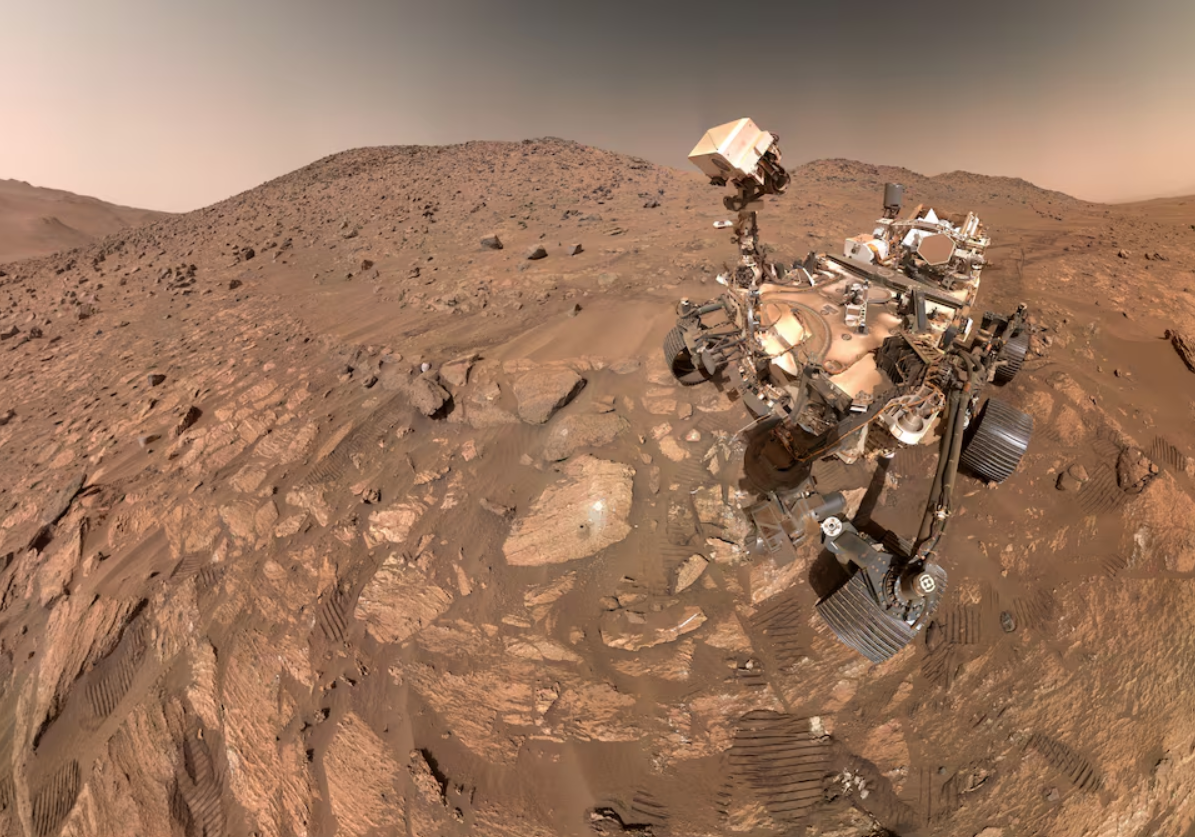
NASA rover Perseverance has discovered one of the strongest pieces of evidence that Mars once may have been a host to microbial life. Scientists presented a sample collected in July 2024 from Jezero Crater containing potential biosignatures i.e. chemical or structural markers that might indicate ancient biological activity.
A team led by Joel Hurowitz of Stony Brook University has published the findings in Nature. It focuses on a fine-grained, rusty-red mudstone from a rock formation called Cheyava Falls. The sample, named Sapphire Canyon, displays unusual ring-shaped and speckled patterns resembling leopard spots and poppy seeds. Researchers believe such features may have originated billions of years ago in a lake environment between 3.2 and 3.8 billion years ago, possibly through microbial processes.
Acting NASA Administrator Sean Duffy told a news conference that the U.S. space agency’s scientists analysed the data for a year and ascertained that “we can’t find another explanation, so this very well could be the clearest sign of life that we’ve ever found on Mars – which is incredibly exciting.”
However, scientists warn against affirming definitive proof of extraterrestrial life. The minerals identified could also form through nonbiological chemical reactions. “It’s not life itself,” emphasised Nicky Fox, the associate administrator, who is working for NASA’s Science Mission Directorate, emphasizing that further critical analysis and proper assessment of its properties is required and necessary.
Since its landing in 2021, the Perseverance rover has been exploring Jezero Crater, once an ancient lake basin in the planet’s northern hemisphere. It has been drilling, analyzing, and sealing samples in preparation for a future mission that aims to return them to Earth. The rover’s discoveries continue to strengthen the case that Mars was once a habitable world.
If confirmed, the evidence from Jezero Crater could mark a landmark step in humanity’s search for life beyond Earth.